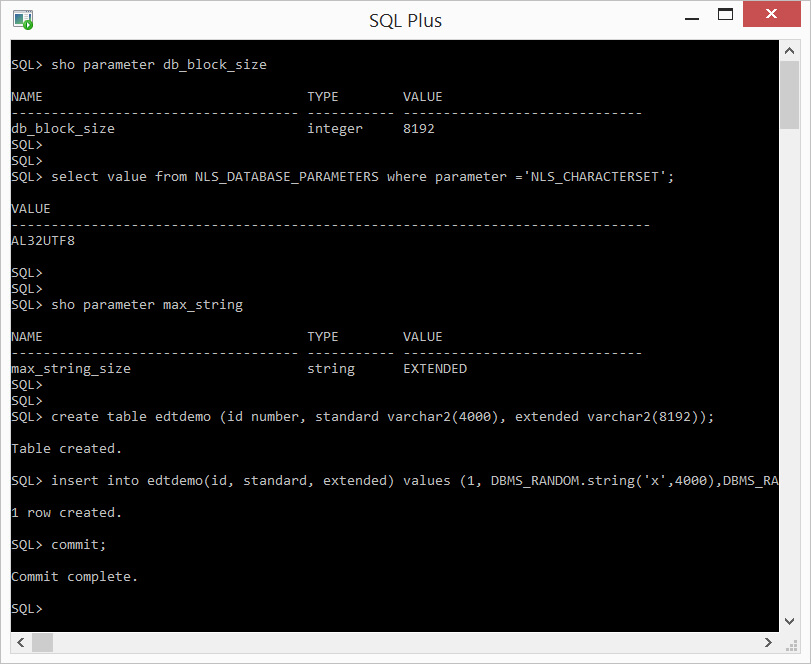
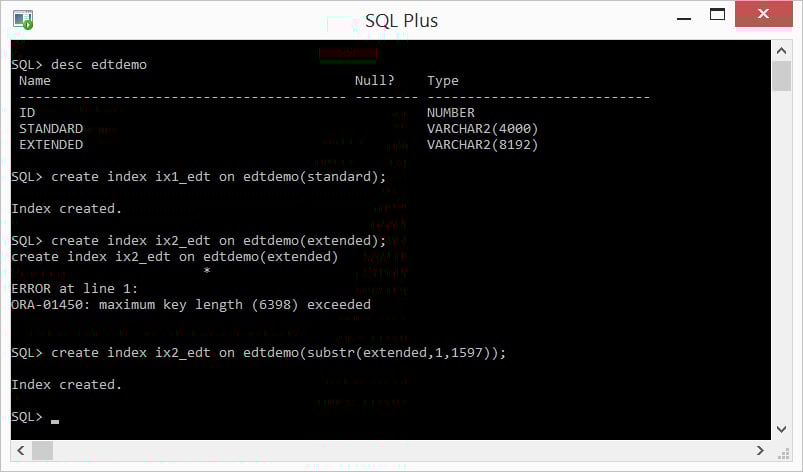
One of the lesser known new features that comes as a boon to many developers and DBAs is the provision of implicit handling of large data strings using scalar data types like VARCHAR2 and RAW.
When creating tables, each column must be assigned a data type, which determines the nature of the values that can be inserted into the column. Common data types include number, date, and varchar2. These data types are also used to specify the nature of arguments for PL/SQL programs like functions and procedures.
When choosing a data type, you must carefully consider the data you plan to store and the operations you may want to perform upon it. Making good decisions at the table design stage reduces the potential negative downstream impact on space utilization and performance. Space is a consideration since some data types occupy a fixed length, consuming the same number of bytes, no matter what data is actually stored in it.
In pre-12c databases, long characters strings of more than 4000 bytes had to be handled using creative solutions including: CLOB or LONG data types and multiple columns or variables. These approaches led to inefficient unnecessarily complex designs and added processing overheads.
12c introduced the MAX_STRING_SIZE system parameter that allows string data types to be much larger when the parameter is changed from its default value of STANDARD to EXTENDED. The VARCHAR2 data type, stores variable length character data from 1 to 4000 bytes if MAX_STRING_SIZE=STANDARD or up to 32767 bytes if MAX_STRING_SIZE=EXTENDED.
RAW and NVARCHAR2 data types are affected in similar ways.
This feature will no doubt be improved and the shortcomings will be dealt with in future releases—but for now, it offers a clean and elegant mechanism for handling large character data within existing applications requiring minimal code changes.
Ready to optimize your Oracle Database for the future?