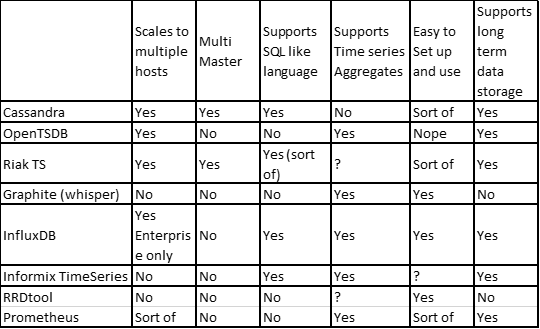


Cassandra 101 : Understanding what Cassandra Is
- Community Edition.- This is distributed under the Apache™ License
- Enterprise Edition .- This is distributed by Datastax
- Consistency.- A read is guaranteed to return the most recent write for a given client.
- Availability.-A non-failing node will return a reasonable response within a reasonable amount of time (no error or timeout).
- Partition Tolerance.-The system will continue to function when network partitions occur.
- Keyspace is the container for your application data, similar to a schema in a relational database. Keyspaces are used to group column families together. Typically, a cluster has one keyspace per application. It also defines the replication strategy and data objects belong to a single keyspace.
- Column Family is a set of one, two, or more individual rows with a similar structure.
- Row is a collection of sorted columns, it is the the smallest unit that stores related data in Cassandra, and any component of a Row can store data or metadata.
- Row Key uniquely identifies a row in a column family.
- Column key uniquely identifies a column value in a row.
- Column value stores one value or a collection of values.
- Row Key uniquely identifies a row in a column family.
- Node is one Cassandra instance and is the basic infrastructure component in Cassandra. Cassandra assigns data to nodes in the cluster; each node is assigned a part of the database based on the Row Key. Usually corresponds to a host, but not necessarily, especially in Dev or Test environments.
- Rack is a logical set of nodes.
- Data Center is a logical set of Racks, a data center can be a physical data center or virtual data center. Replication is set by data center.
- Cluster contains one or more data centers and is the full set of nodes which map to a single complete token ring.
Learn more about Pythian's Cassandra Services or get a free cassandra assessment today.
Related Blog Posts André Araújo, a great friend of mine and previous Pythianite, wrote about his first experience with Cassandra. The original post was published on René Antúnez’s blog.On this page
Share this
Share this
More resources
Learn more about Pythian by reading the following blogs and articles.
Backup strategies in Cassandra
May 25, 2018 12:00:00 AM
4
min read
Cassandra Vulnerability - CVE-2020-13946 - Apache Cassandra RMI Rebind Vulnerability
Sep 2, 2020 12:00:00 AM
1
min read
Cassandra use cases: when to use and when not to use cassandra
Mar 21, 2018 12:00:00 AM
6
min read
Ready to unlock value from your data?
With Pythian, you can accomplish your data transformation goals and more.