


Share this
Unlocking the Power of Personalized AI with Azure OpenAI Service and Cognitive Search
by Warner Chaves on Oct 17, 2023 12:24:48 PM
In today's data-driven world, businesses and individuals rely on cloud services to store, share, and manage their information. Integrating advanced technologies, like natural language processing (NLP) models, into these services has transformed how we interact with data.
Two such services, "Azure OpenAI Service" and "Azure Cognitive Search," have joined forces to usher in a new era of personalized AI-driven experiences. In this blog post, we'll explore why this integration is essential, delve into the concept of embedding vectors from documents, and distinguish between regular keyword search and semantic search. Finally, we'll leave you with a step-by-step demo of configuring this powerful scenario.
Integrating Search with AI
In the age of information overload, personalization is the key to efficient data handling. Azure OpenAI, hosting the robust ChatGPT model, provides the perfect interface for users to interact with their data, making it more accessible and actionable.
To complement this capability, we have Cognitive Search. It does this by indexing and organizing users' data from cloud storage for rich search experiences. To take it to the next level, it can now leverage this data as context for Azure OpenAI, enabling the AI model to generate highly relevant and personalized responses.
The integration empowers users to extract insights, generate content, and make informed decisions by fusing the power of language models with the richness of their own data.
Creating Embedding Vectors from Documents
Embedding vectors are numerical representations of words or documents that enable multiple different types of algorithms or computations on text (https://en.wikipedia.org/wiki/Word_embedding). These vectors capture semantic meaning, allowing machines to understand the relationships between words and documents.
Cognitive Search uses an embedding model to convert text documents into embedding vectors. This process transforms plain text into mathematical representations, making it easier to compare and analyze documents based on their content. So, the search can measure the distance between documents as well as measure which documents are better fit to answer a particular question.
With document embeddings, users can explore their data in new ways, from finding similar documents to detecting trends and anomalies. This technology forms the foundation for both semantic and keyword-based searches.
The traditional keyword search method relies on matching specific words or phrases within documents. While efficient, it might miss documents that use synonyms or related terms. Cognitive Search's keyword search capability ensures precise matches but might not capture the full context.
Semantic search, on the other hand, takes advantage of document embeddings to understand the context and meaning behind words. It can find documents related to a query even if they don't contain the exact keywords. This enables a more comprehensive and accurate retrieval of information.
The cool thing here is that both Vector-only, vector plus semantic search as well as vector plus simple search are available, so you can use the method that provides the best results for your use case.
This approach is also much more efficient than fine-tuning a massive model like GPT to achieve something similar.
Fine-tuning vs. External Context
If you are familiar with LLMs, you might have heard of the concept of fine-tuning. Fine-tuning is when an LLM model is trained on a specific body of knowledge or sub-task that was not part of its original training data. This can allow the model to exhibit deeper knowledge or new behavior but it comes at a high compute cost since re-training is necessary. Overfitting is also a common issue with fine-tuning, where the model is so focused on the specific re-training area that it loses a large part of its general knowledge.
The “Bring your own data” approach in Azure OpenAI is not fine-tuning. It is bringing external context information to the LLM model as part of the process of answering a message. The benefit of this approach is that you can immediately get the benefits of the new data without having to go through a training process, and you can integrate new data sources very easily. The downside is that you are still working with the general model behind the scenes, which might not be as detailed or exhibit the understanding of this specific data that you would like.
In general, it makes sense to start by trying out the external context approach first since it is faster and less resource-consuming to implement. Ultimately, the choice between doing a full fine-tuning process or just feeding external context to the LLM will depend on your use case for the technology and whether the results meet your expectations.
Demo: Configuring the Integration
I want to show in this post the current experience of using your own data with an LLM model using the Azure AI Studio.
First, you will notice the option of “Bring your own data” as soon as you enter the Azure AI Studio portal. You will also notice that right now, this capability is in preview, so it’s all expected to change and be adjusted as Microsoft makes this generally available.
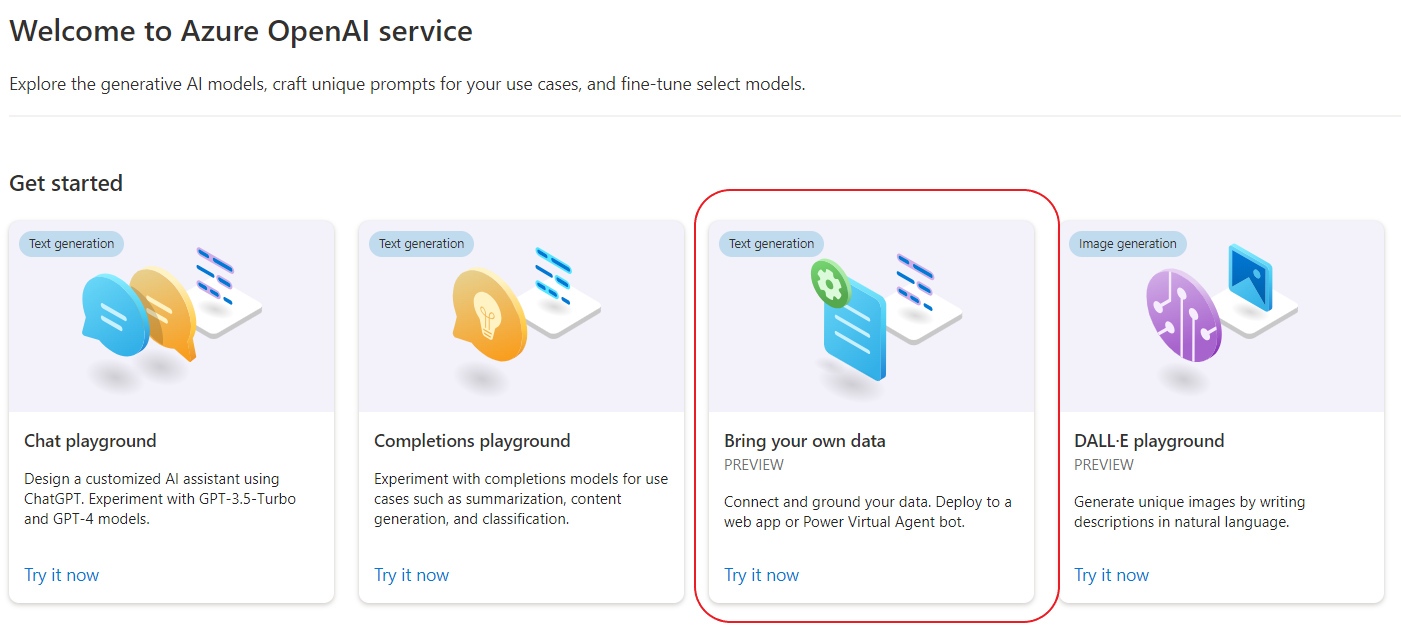
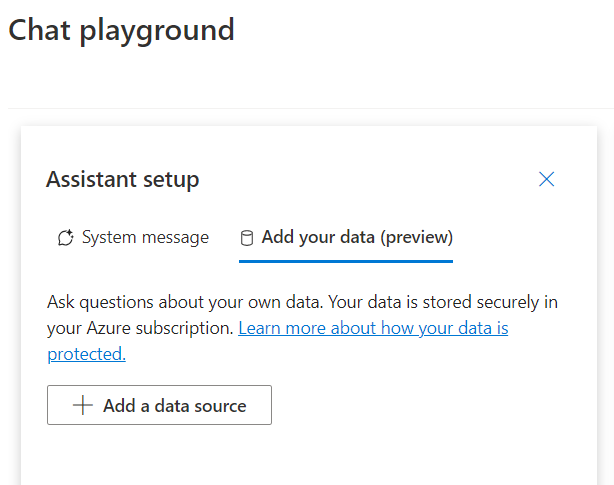
The first step is to provide the data source. Currently, the options are either a Cognitive Search index, an Azure Blob Storage container, or to upload files manually through the portal.
In the image below, you can see the information that is required to make this work. In this scenario, I’m using my own storage account, the service will require a Cognitive Search service to host the index, and if you want to generate vector embeddings, then you need a text embedding model, too.
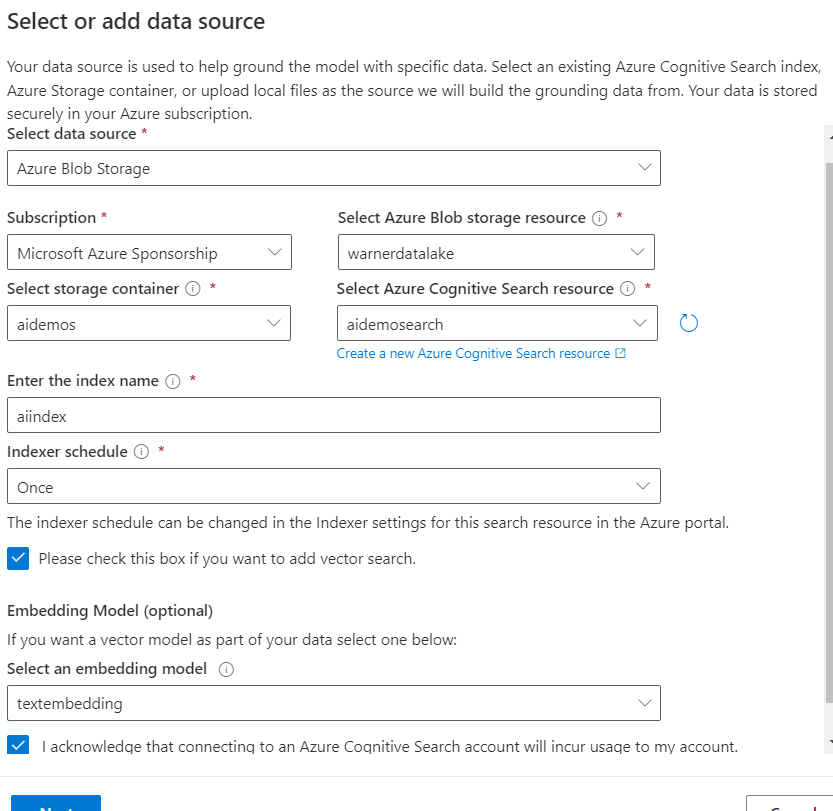
If you do decide to generate vectors, then you have the options of just vector search, vector plus semantic search, and vector plus simple keyword search. The differences between these methods I already covered previously in this post.
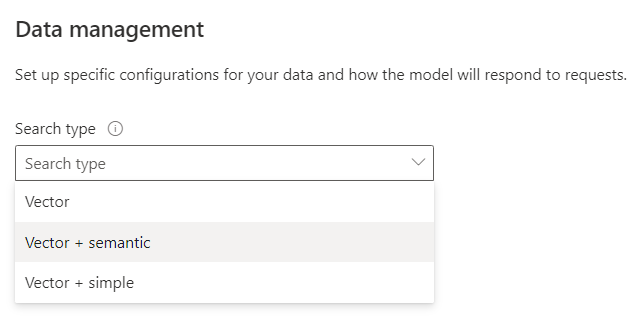
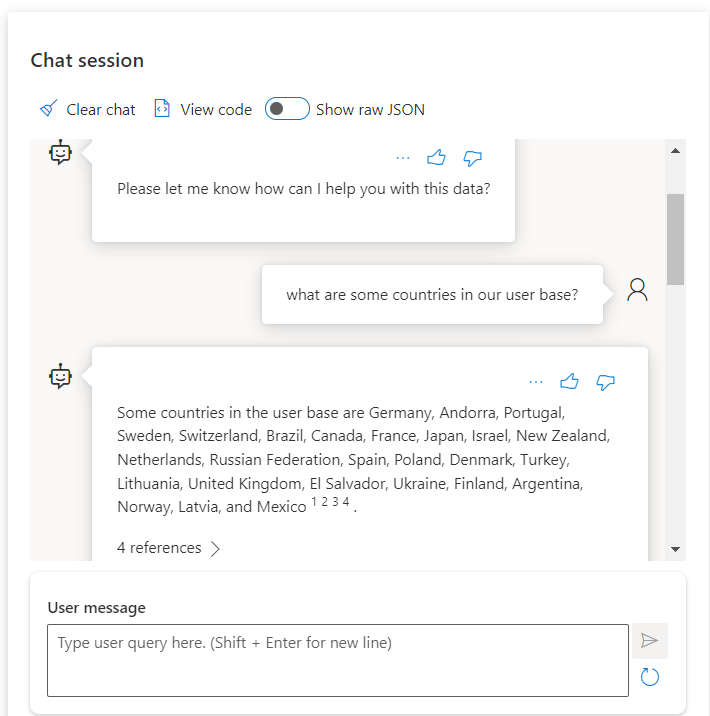
Once you have saved the configuration, the service will kick in and create your Cognitive Search index to use with the LLM. You can, of course, access this LLM with the API if you are developing a real application, however, for testing purposes, you can interact right away in a chat session on the web portal.
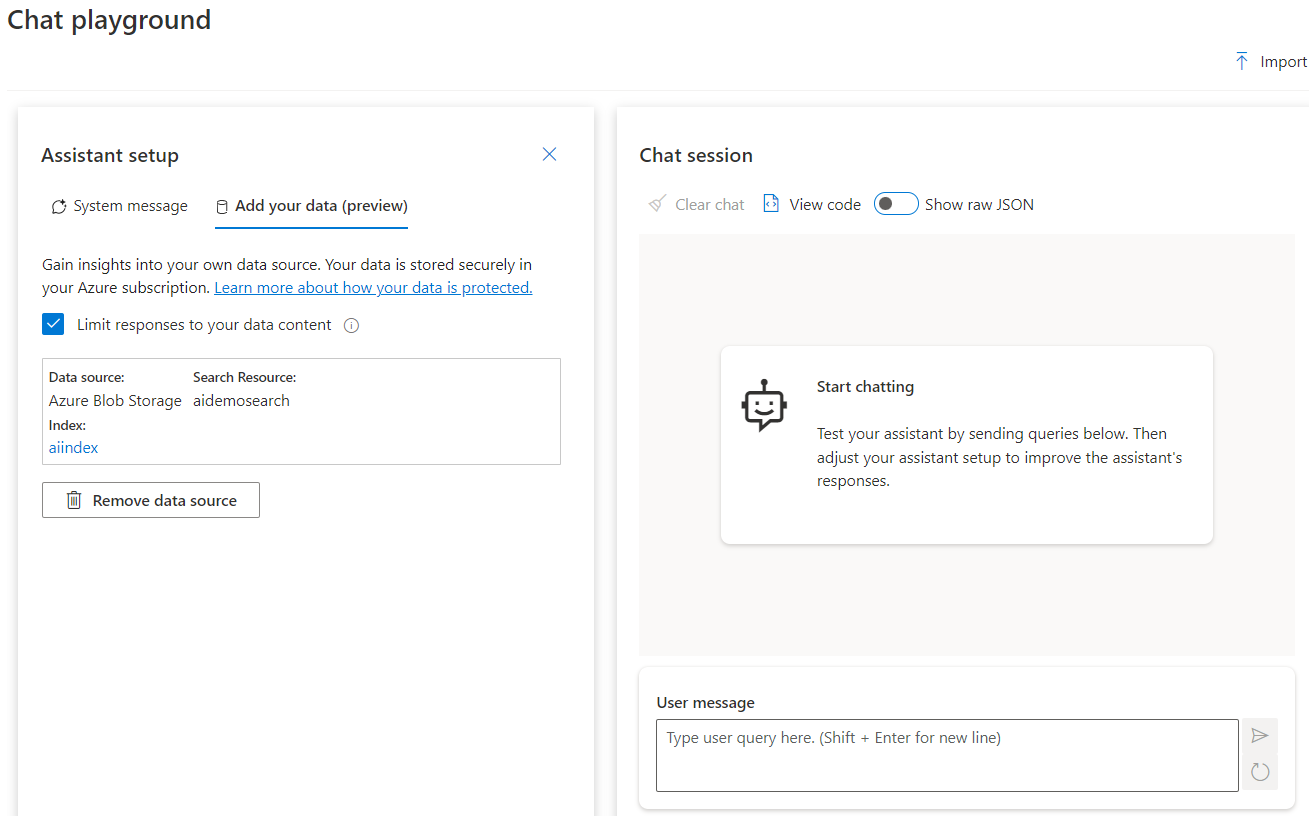
You can see from the screenshot that when I ask a question to the LLM, it gives me an answer, and it even includes the references it has used to generate it.
This portal process is very nice for testing and experimenting and can get someone up and running very quickly. For a true production scenario, we would be looking at a fully automated deployment of all these services and API testing routines with some pre-made interactions with the LLM to ensure that the accuracy is high and the rate of misses or hallucinations is low.
Conclusion
In conclusion, the integration of Azure OpenAI service and Cognitive Search represents a significant leap forward in the world of personalized AI. By harnessing the power of embedding vectors and offering both semantic and keyword-based search capabilities, this integration promises to revolutionize the way we interact with our data and opens the door to all kinds of soon-to-exist advanced user text and chat capabilities.
Share this
- Technical Track (816)
- Oracle (488)
- Database (229)
- MySQL (144)
- Cloud (133)
- Microsoft SQL Server (124)
- Open Source (84)
- Google Cloud (82)
- Microsoft Azure (67)
- Amazon Web Services (AWS) (63)
- Big Data (50)
- Cassandra (44)
- Google Cloud Platform (44)
- DevOps (38)
- Linux (28)
- Pythian (27)
- PostgreSQL (26)
- Podcasts (25)
- Site Reliability Engineering (23)
- Performance (22)
- Docker (21)
- Oracle E-Business Suite (21)
- DBA (18)
- Oracle Cloud Infrastructure (OCI) (18)
- MongoDB (17)
- Security (17)
- Hadoop (16)
- BigQuery (15)
- Amazon RDS (14)
- Automation (14)
- Exadata (14)
- Oracleebs (14)
- Snowflake (14)
- Ansible (13)
- Oracle Database (13)
- Oracle Exadata (13)
- ASM (12)
- Data (12)
- LLM (12)
- Artificial Intelligence (AI) (11)
- GenAI (11)
- Kubernetes (11)
- Machine Learning (11)
- Advanced Analytics (10)
- Datascape Podcast (10)
- Oracle Applications (10)
- Replication (10)
- Authentication, SSO and MFA (8)
- ChatGPT (8)
- Cloud Migration (8)
- Infrastructure (8)
- Monitoring (8)
- Percona (8)
- Analytics (7)
- Apache (7)
- Apache Cassandra (7)
- Data Governance (7)
- High Availability (7)
- Mariadb (7)
- Microsoft Azure SQL Database (7)
- Myrocks (7)
- Oracle EBS (7)
- Python (7)
- Rman (7)
- SAP (7)
- Series (7)
- AWR (6)
- Airflow (6)
- Apache Beam (6)
- Data Guard (6)
- Innodb (6)
- Migration (6)
- Oracle Enterprise Manager (OEM) (6)
- Orchestrator (6)
- RocksDB (6)
- Azure Synapse Analytics (5)
- Covid-19 (5)
- Data Enablement (5)
- Disaster Recovery (5)
- Microsoft (5)
- Performance Tuning (5)
- Scala (5)
- Serverless (5)
- Cloud Security (4)
- Cloud Spanner (4)
- CockroachDB (4)
- Data Management (4)
- Data Pipeline (4)
- Data Security (4)
- Data Strategy (4)
- Data Visualization (4)
- Databases (4)
- Dataflow (4)
- Generative AI (4)
- Google (4)
- Google BigQuery (4)
- Oracle Autonomous Database (Adb) (4)
- Oracle Cloud (4)
- Oracle Enterprise Manager (4)
- Redhat (4)
- Ssl (4)
- Windows (4)
- Xtrabackup (4)
- Amazon Relational Database Service (Rds) (3)
- Apex (3)
- Cloud Database (3)
- Cloud FinOps (3)
- Data Analytics (3)
- Data Migrations (3)
- Database Migration (3)
- Digital Transformation (3)
- ERP (3)
- Google Chrome (3)
- Google Cloud Sql (3)
- Google Workspace (3)
- Heterogeneous Database Migration (3)
- Oracle Live Sql (3)
- Oracle Rac (3)
- Perl (3)
- Power Bi (3)
- Prometheus (3)
- Remote Teams (3)
- Slob (3)
- Tensorflow (3)
- Terraform (3)
- Amazon Data Migration Service (2)
- Amazon Ec2 (2)
- Anisble (2)
- Apache Flink (2)
- Apache Kafka (2)
- Apexexport (2)
- Ashdump (2)
- Aurora (2)
- Azure Data Factory (2)
- Cloud Armor (2)
- Cloud Data Fusion (2)
- Cloud Hosting (2)
- Cloud Infrastructure (2)
- Cloud Shell (2)
- Cloud Sql (2)
- Conferences (2)
- Cosmos Db (2)
- Cosmosdb (2)
- Cost Management (2)
- Data Discovery (2)
- Data Integration (2)
- Data Quality (2)
- Data Streaming (2)
- Database Administrator (2)
- Database Consulting (2)
- Database Monitoring (2)
- Database Performance (2)
- Database Troubleshooting (2)
- Dataguard (2)
- Dataops (2)
- Enterprise Data Platform (EDP) (2)
- Events (2)
- Fusion Middleware (2)
- Gemini (2)
- Graphite (2)
- Infrastructure As Code (2)
- Innodb Cluster (2)
- Innodb File Structure (2)
- Innodb Group Replication (2)
- Liquibase (2)
- NLP (2)
- Nosql (2)
- Oracle Data Guard (2)
- Oracle Datase (2)
- Oracle Flashback (2)
- Oracle Forms (2)
- Oracle Installation (2)
- Oracle Io Testing (2)
- Podcast (2)
- Rdbms (2)
- Redshift (2)
- Remote DBA (2)
- Remote Sre (2)
- S3 (2)
- Single Sign-On (2)
- Webinars (2)
- X5 (2)
- AI (1)
- Actifio (1)
- Adop (1)
- Advanced Data Services (1)
- Afd (1)
- Alloydb (1)
- Amazon (1)
- Amazon Aurora Backtrack (1)
- Amazon Efs (1)
- Amazon Redshift (1)
- Amazon S3 (1)
- Amazon Sagemaker (1)
- Amazon Vpc Flow Logs (1)
- Analysis (1)
- Analytical Models (1)
- Anthos (1)
- Application Migration (1)
- Ash (1)
- Asmlib (1)
- Atp (1)
- Autonomous (1)
- Awr Data Mining (1)
- Awr Mining (1)
- Azure Data Lake (1)
- Azure Data Lake Analytics (1)
- Azure Data Lake Store (1)
- Azure Data Migration Service (1)
- Azure OpenAI (1)
- Azure Sql Data Warehouse (1)
- Batches In Cassandra (1)
- Business Insights (1)
- Business Intelligence (1)
- Chown (1)
- Chrome Security (1)
- Cloud Browser (1)
- Cloud Build (1)
- Cloud Consulting (1)
- Cloud Cost Optimization (1)
- Cloud Data Warehouse (1)
- Cloud Database Management (1)
- Cloud Dataproc (1)
- Cloud Foundry (1)
- Cloud Networking (1)
- Cloud SQL Replica (1)
- Cloud Scheduler (1)
- Cloud Services (1)
- Cloud Strategies (1)
- Compliance (1)
- Conversational AI (1)
- Cyber Security (1)
- Data Analysis (1)
- Data Analytics Platform (1)
- Data Box (1)
- Data Classification (1)
- Data Cleansing (1)
- Data Encryption (1)
- Data Engineering (1)
- Data Estate (1)
- Data Insights (1)
- Data Integrity (1)
- Data Leader (1)
- Data Lifecycle Management (1)
- Data Lineage (1)
- Data Masking (1)
- Data Mesh (1)
- Data Migration (1)
- Data Migration Assistant (1)
- Data Migration Service (1)
- Data Mining (1)
- Data Monetization (1)
- Data Policy (1)
- Data Profiling (1)
- Data Protection (1)
- Data Retention (1)
- Data Safe (1)
- Data Sheets (1)
- Data Summit (1)
- Data Vault (1)
- Data Warehouse (1)
- Database Consultant (1)
- Database Link (1)
- Database Management (1)
- Database Migrations (1)
- Database Modernization (1)
- Database Provisioning (1)
- Database Provisioning Failed (1)
- Database Replication (1)
- Database Schemas (1)
- Database Upgrade (1)
- Databricks (1)
- Datascape 59 (1)
- DeepSeek (1)
- Docker-Composer (1)
- Duet AI (1)
- Edp (1)
- Etl (1)
- Gcp Compute (1)
- Gcp-Spanner (1)
- Global Analytics (1)
- Google Analytics (1)
- Google Cloud Architecture Framework (1)
- Google Cloud Data Services (1)
- Google Cloud Partner (1)
- Google Cloud Spanner (1)
- Google Cloud VMware Engine (1)
- Google Compute Engine (1)
- Google Dataflow (1)
- Google Datalab (1)
- Google Grab And Go (1)
- Graph Algorithms (1)
- Graph Inferences (1)
- Graph Theory (1)
- GraphQL (1)
- Health Check (1)
- Healthcheck (1)
- Information (1)
- Infrastructure As A Code (1)
- Innobackupex (1)
- Innodb Concurrency (1)
- Innodb Flush Method (1)
- It Industry (1)
- Kubeflow (1)
- LMSYS Chatbot Arena (1)
- Linux Host Monitoring (1)
- Linux Storage Appliance (1)
- Looker (1)
- MMLU (1)
- Managed Services (1)
- Migrate (1)
- Neo4J (1)
- Newsroom (1)
- Nifi (1)
- OPEX (1)
- Odbcs (1)
- Odbs (1)
- On-Premises (1)
- Open Source Database (1)
- Ora-01852 (1)
- Ora-7445 (1)
- Oracle Cursor (1)
- Oracle Database@Google Cloud (1)
- Oracle Exadata Smart Scan (1)
- Oracle Licensing (1)
- Oracle Linux Virtualization Manager (1)
- Oracle Oda (1)
- Oracle Openworld (1)
- Oracle Parallelism (1)
- Oracle RMAN (1)
- Oracle Rdbms (1)
- Oracle Real Application Clusters (1)
- Oracle Reports (1)
- Oracle Security (1)
- Perfomrance (1)
- Performance Schema (1)
- Policy (1)
- Prompt Engineering (1)
- Public Cloud (1)
- Pythian News (1)
- Rdb (1)
- Replication Error (1)
- Retail (1)
- SAP HANA Cloud (1)
- Securing Sql Server (1)
- Serverless Computing (1)
- Sso (1)
- Tenserflow (1)
- Teradata (1)
- Vertex AI (1)
- Videos (1)
- Workspace Security (1)
- Xbstream (1)
- August 2025 (1)
- July 2025 (3)
- June 2025 (1)
- May 2025 (3)
- March 2025 (2)
- February 2025 (1)
- January 2025 (2)
- December 2024 (1)
- October 2024 (2)
- September 2024 (7)
- August 2024 (4)
- July 2024 (2)
- June 2024 (6)
- May 2024 (3)
- April 2024 (2)
- February 2024 (1)
- January 2024 (11)
- December 2023 (10)
- November 2023 (9)
- October 2023 (11)
- September 2023 (9)
- August 2023 (6)
- July 2023 (2)
- June 2023 (13)
- May 2023 (4)
- April 2023 (6)
- March 2023 (10)
- February 2023 (6)
- January 2023 (5)
- December 2022 (10)
- November 2022 (10)
- October 2022 (10)
- September 2022 (13)
- August 2022 (16)
- July 2022 (12)
- June 2022 (13)
- May 2022 (11)
- April 2022 (4)
- March 2022 (5)
- February 2022 (4)
- January 2022 (14)
- December 2021 (16)
- November 2021 (11)
- October 2021 (6)
- September 2021 (11)
- August 2021 (6)
- July 2021 (9)
- June 2021 (4)
- May 2021 (8)
- April 2021 (16)
- March 2021 (16)
- February 2021 (6)
- January 2021 (12)
- December 2020 (12)
- November 2020 (17)
- October 2020 (11)
- September 2020 (10)
- August 2020 (11)
- July 2020 (13)
- June 2020 (6)
- May 2020 (9)
- April 2020 (18)
- March 2020 (21)
- February 2020 (13)
- January 2020 (15)
- December 2019 (10)
- November 2019 (11)
- October 2019 (12)
- September 2019 (16)
- August 2019 (15)
- July 2019 (10)
- June 2019 (16)
- May 2019 (20)
- April 2019 (21)
- March 2019 (14)
- February 2019 (18)
- January 2019 (18)
- December 2018 (5)
- November 2018 (16)
- October 2018 (12)
- September 2018 (20)
- August 2018 (27)
- July 2018 (31)
- June 2018 (34)
- May 2018 (28)
- April 2018 (27)
- March 2018 (17)
- February 2018 (8)
- January 2018 (20)
- December 2017 (14)
- November 2017 (4)
- October 2017 (1)
- September 2017 (3)
- August 2017 (5)
- July 2017 (4)
- June 2017 (2)
- May 2017 (7)
- April 2017 (7)
- March 2017 (8)
- February 2017 (8)
- January 2017 (5)
- December 2016 (3)
- November 2016 (4)
- October 2016 (8)
- September 2016 (9)
- August 2016 (10)
- July 2016 (9)
- June 2016 (8)
- May 2016 (13)
- April 2016 (16)
- March 2016 (13)
- February 2016 (11)
- January 2016 (6)
- December 2015 (11)
- November 2015 (11)
- October 2015 (5)
- September 2015 (16)
- August 2015 (4)
- July 2015 (1)
- June 2015 (3)
- May 2015 (6)
- April 2015 (5)
- March 2015 (5)
- February 2015 (4)
- January 2015 (3)
- December 2014 (7)
- October 2014 (4)
- September 2014 (6)
- August 2014 (6)
- July 2014 (16)
- June 2014 (7)
- May 2014 (6)
- April 2014 (5)
- March 2014 (4)
- February 2014 (10)
- January 2014 (6)
- December 2013 (8)
- November 2013 (12)
- October 2013 (9)
- September 2013 (6)
- August 2013 (7)
- July 2013 (9)
- June 2013 (7)
- May 2013 (7)
- April 2013 (4)
- March 2013 (7)
- February 2013 (4)
- January 2013 (4)
- December 2012 (6)
- November 2012 (8)
- October 2012 (9)
- September 2012 (3)
- August 2012 (5)
- July 2012 (5)
- June 2012 (7)
- May 2012 (11)
- April 2012 (1)
- March 2012 (8)
- February 2012 (1)
- January 2012 (6)
- December 2011 (8)
- November 2011 (5)
- October 2011 (9)
- September 2011 (6)
- August 2011 (4)
- July 2011 (1)
- June 2011 (1)
- May 2011 (5)
- April 2011 (2)
- February 2011 (2)
- January 2011 (2)
- December 2010 (1)
- November 2010 (7)
- October 2010 (3)
- September 2010 (8)
- August 2010 (2)
- July 2010 (4)
- June 2010 (7)
- May 2010 (2)
- April 2010 (1)
- March 2010 (3)
- February 2010 (3)
- January 2010 (2)
- November 2009 (6)
- October 2009 (6)
- August 2009 (3)
- July 2009 (3)
- June 2009 (3)
- May 2009 (2)
- April 2009 (8)
- March 2009 (6)
- February 2009 (4)
- January 2009 (3)
- November 2008 (3)
- October 2008 (7)
- September 2008 (6)
- August 2008 (9)
- July 2008 (9)
- June 2008 (9)
- May 2008 (9)
- April 2008 (8)
- March 2008 (4)
- February 2008 (3)
- January 2008 (3)
- December 2007 (2)
- November 2007 (7)
- October 2007 (1)
- August 2007 (4)
- July 2007 (3)
- June 2007 (8)
- May 2007 (4)
- April 2007 (2)
- March 2007 (2)
- February 2007 (5)
- January 2007 (8)
- December 2006 (1)
- November 2006 (3)
- October 2006 (4)
- September 2006 (3)
- July 2006 (1)
- May 2006 (2)
- April 2006 (1)
- July 2005 (1)
Comments (1)