



Every conversation about AI seems to gravitate toward the cinematic: fully autonomous fulfillment networks, self-healing freight routes, and agents making multi-million-dollar inventory bets without human intervention.
Those stories make for gripping keynote slides. They also paint a misleading picture of what it takes to deploy AI for supply chain operations inside a real enterprise.
At TECH-CHAIN 2026, hosted by the Saint Louis University Center for Supply Chain Excellence, I shared a pragmatic counter-narrative for enterprise leaders navigating this hype cycle: Make AI boring enough to work.
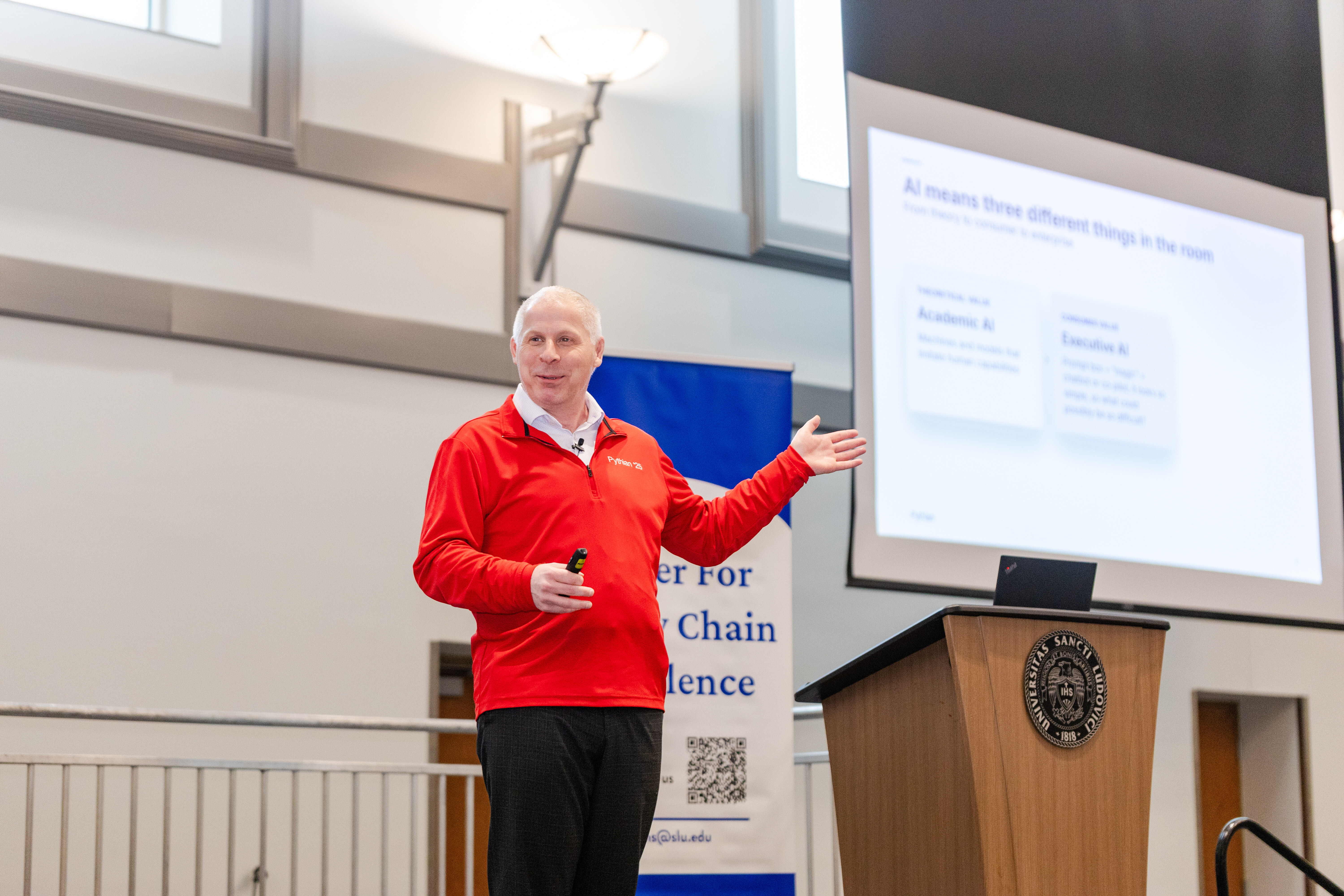
Thanks to Saint Louis University and the Tech-Chain community for the opportunity to share this perspective, and to everyone doing the unglamorous work of making enterprise technology actually work.
Make AI boring enough to work.
The real enterprise value of AI for supply chain operations doesn't come from theatrical demonstrations. It comes from the unglamorous, predictable, and governed automation of everyday friction.
My job is boring. Your job is boring. All our jobs are boring. Not meaningless. Not unimportant. Boring in the sense that most of the work that makes a global supply chain function is not performed for applause. It is performed consistently and safely. We solve problems, move freight, manage risk, reconcile data, and keep the operation moving. The goal is not to make every task exciting. The goal is to move the needle toward a safe, predictable, growing business. Enterprise AI and IoT should be held to that exact standard.
In other words: You don't have to predict the future. You just need to build something boring but useful.
Case in point: the convergence of AI and IoT in supply chain operations
A flashy demo is not a working operating model, and an algorithmic capability is not a business outcome. In modern logistics, predictive analytics and machine learning models are only valuable if they transform work in a reliable way. Real value appears only when technology changes how daily logistics work gets done, in a way operators can trust and the business can sustain.
A great example of this is the integration of AI and IoT in supply chain networks:
- The cinematic pitch: Autonomous agentic networks that dynamically re-route entire global ocean freight lanes based on macro geopolitical signals.
- The boring reality that actually works: IoT sensors continuously monitor temperature, vibration, and humidity for perishables and pharmaceuticals; AI detects micro-trends to predict spoilage so a logistics partner can intervene before losing inventory.
The same principle applies to catalog data. Inbound supplier descriptions, customs codes, packaging dimensions, and specs arrive in conflicting formats and varying quality. Using natural language processing to identify inconsistencies, clear the obvious matches, and route the true exceptions to a human specialist prevents warehouse sorting jams and fulfillment errors downstream.
When successfully paired, AI and IoT in supply chain ecosystems do not necessarily replace human intervention. Instead, they filter out the industrial noise so you can take structured, high-priority actions to prevent downstream errors costing time, money, and customer trust. Identify the right operational profile: frequent enough to matter, bounded enough to control, and measurable enough to evaluate.
-
Frequent enough to matter: Repetitive processes that occur hundreds or thousands of times daily across your warehouse or shipping nodes.
-
Bounded enough to control: Workflows with clear data inputs, strict system boundaries, and known failure modes.
-
Measurable enough to evaluate: Tasks directly tied to quantifiable operational metrics (like order cycle times or scrap rates) rather than abstract productivity scores.
How to identify high-impact AI use cases for supply chain modernization
“Start small” is often mistaken for “think small.” They are not the same.
When evaluating where to deploy machine learning and AI in supply chain operations, ignore the temptation to tackle massive, sprawling problems. A narrow first deployment is the quickest way to learn what scaling AI in supply chain management actually requires: which data pipelines matter, where exceptions crop up, how decisions get made, what controls are needed, and who owns the result. It gives the organization evidence before it makes a larger bet.
Ask yourself these questions:
- What exact operational baseline must change?
- What counts as a good result?
- Who is accountable when the system is uncertain or wrong?
- Have we accounted for the unglamorous total cost of ownership—data hygiene, sensor calibration, monitoring, and integration?
- What specific failure threshold causes us to stop?
Those questions are not bureaucratic paperwork wrapped around innovation. They are part of the system design. The same discipline applies to capacity. “Hours saved” is not automatically a financial result. Released capacity has value only when the business makes a deliberate operational choice about what to do with it, or when it avoids spend that would otherwise have occurred. Measure the operational outcome, not the volume of tasks touched.
Examples of high-impact use cases would be:
- Supplier catalog and spec verification: Multi-vendor product descriptions, dimensional data, customs codes, and packaging specifications arrive in conflicting formats and variable quality. Applying Natural Language Processing (NLP) to clean up and organize this data prevents warehouse sorting jams and customer fulfillment errors.
- Predictive maintenance via IoT vibration feeds: Pairing vibration and thermal IoT sensors on warehouse conveyor belts with predictive ML models identifies mechanical wear before a catastrophic line stoppage occurs.
- Automated invoice and Bill of Lading (BOL) matching: Cross-checking purchase orders, IoT arrival scans, and freight invoices to catch billing discrepancies before payment goes out.
These are not moonshots. They are specific use cases in a real process, with a clear space for human judgment.
Integrating people into the AI and IoT operating model
One of the biggest mistakes when implementing AI in supply chains is treating humans as an unowned fallback, expecting unprepared workers to suddenly fix complex problems the moment the autonomous system fails.
 That is not a system design. It is an unowned operational failure.
Sustainable use of AI in supply chain operations requires deliberate human-in-the-loop governance with:
- Predefined authority limits: Establish strict rules for what an automated system can execute autonomously (e.g., auto-approving supplier invoices under $5,000 with a 99.5% match rate) versus what requires human authorization.
- Context-rich escalations: When uncertainty arises, route the edge case to a domain specialist along with the model’s confidence score, rationale, and supporting IoT sensor data.
- Continuous auditing: Ensure operators retain the visibility and authority to override algorithmic recommendations without breaking upstream workflows.
As supply chains advance toward autonomous multi-agent systems, deliberate AI governance (not just the algorithm itself) becomes your true competitive edge.
The 4-step framework to scale AI in your supply chain
Scaling enterprise AI is not just a matter of budget size. Before expanding an initial pilot across your global operations, validate it through this four-part checklist:
|
Phase |
Core objective |
Key question to answer |
|
1. Ground baseline metrics |
Tie work to hard business outcomes. |
What exact baseline (e.g., dock-to-stock time, scrap rate, exception cost) must change? |
|
2. Calculate TCO |
Factor in operational realities. |
Have we accounted for data pipeline hygiene, edge sensor calibration, and ongoing drift monitoring? |
|
3. Validate capacity value |
Avoid paper savings. |
Are "hours saved" tied to real capacity redeployment or tangible cost avoidance? |
|
4. Exercise kill criteria |
Preserve investment discipline. |
What threshold of error, data drift, or stagnation triggers a redesign or immediate shutdown of this pilot? |
 Key takeaway: A strategy that can launch AI pilots but lacks the organizational discipline to terminate underperforming, low-impact solutions is not a strategy—it’s just an expensive queue.
Embrace the boring: building a defensible supply chain moat
The real benchmark of successfully deploying AI for supply chain operations is not how dazzling a demo looks. It’s whether it can make your logistics network more resilient, your data cleaner, and your operating margins more defensible.
When you combine solid cloud data engineering, IoT sensor networks, and targeted artificial intelligence, you build a modern business capable of sustainable growth.
That background work might look boring, but boring scales. And it certainly beats the panic of watching the exciting yet ungoverned pilot derail critical operations.
Modernize your supply chain with Pythian
Implementing production-ready, governed AI and IoT in supply chain networks requires a robust operational model. Pythian delivers enterprise-grade AI Strategy Consulting to help you deploy automated workflows that drive sustainable margin growth.
Share this
Share this
Manufacturing the future: How Sanmina is scaling AI
The Executive’s AI Assistant: Gemini for Strategic Planning and Growth