



Google’s New Vision: What the Agent Platform Actually Is
Gemini Enterprise Agent Platform is Google’s evolution of Vertex AI, announced at Cloud Next. All future Vertex AI services and roadmap investments will be delivered exclusively through the Agent Platform.
For building, you get Agent Studio for low-code visual development and an upgraded Agent Development Kit (ADK) for code-first engineering teams.
- For scaling: Agent Runtime supports long-running agents that maintain state for days, backed by Memory Bank for persistent context across sessions.
- For governance: Agent Identity, Agent Registry, and Agent Gateway give every agent a trackable identity and a controlled entry point into your systems.
- For optimisation: Agent Simulation, Agent Evaluation, and Agent Observability provide full execution traces and real-time visibility into what your agents are doing and why.
- For foundation: Over 200 models are available through Model Garden, including Gemini 3.1 Pro, Gemma 4, and third-party models including Claude.
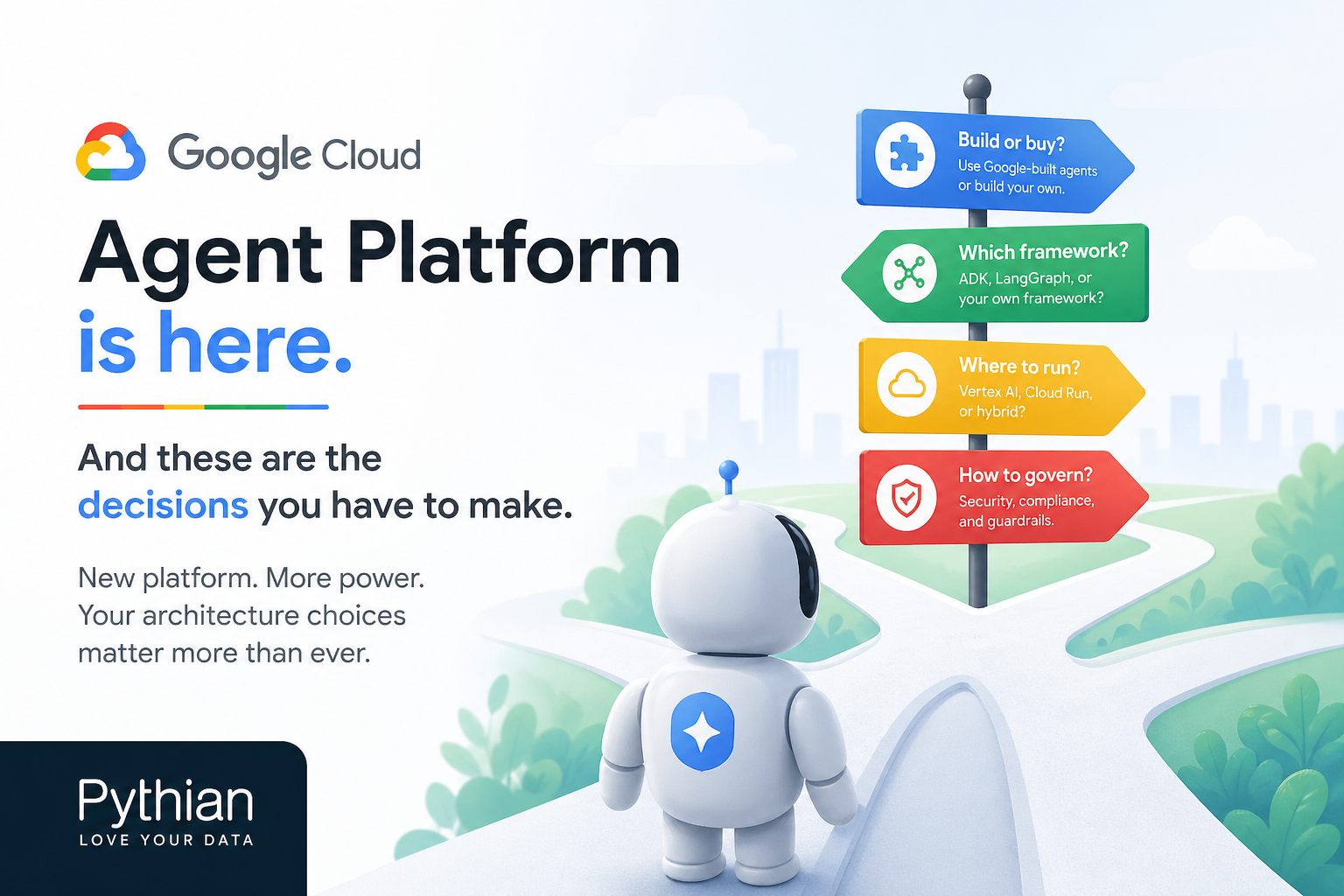
Strategic Requirements: Five Decisions You Must Make
The shift to an agentic enterprise is not a simple "flip of a switch." This new platform forces you to decide on five critical architectural and operational paths:
Decision 1: What Happens to Your Existing Vertex AI Setup?
This is not a migration deadline, but it is a direction. The longer you treat Vertex AI and Agent Platform as separate things, the more technical debt is added. Workloads closest to agentic patterns move first. Pure model inference has more runway. Map your current footprint before you do anything else.
Decision 2: Who Gets to Build Agents, and Through What Path?
Agent Studio and ADK are not just different tools. They imply different builders, different risk profiles, and different review requirements. If non-engineering teams can build agents in Agent Studio, you need a defined review path before you enable it, not after the first agent touches a production system.
Decision 3: What Does Agent Identity Actually Require You to Own?
Agent Identity, Agent Registry, and Agent Gateway give you the infrastructure for agent governance. They do not give you the governance model. Who is accountable for each agent’s behaviour after it is deployed? What is it authorised to access? What happens when it acts outside its intended scope? Those definitions must come from you, and for regulated organisations, they need to map to existing access control and audit frameworks.
Decision 4: What Are Your Acceptance Criteria for an Agent Going to Production?
Agent Simulation and Agent Evaluation are only as useful as the criteria you bring to them. Before you run your first evaluation, you need to define what acceptable looks like: task completion thresholds, failure modes that block deployment, edge case handling. Most organisations do not have these yet because their existing quality gates were designed for deterministic software, not systems that reason their way to a decision.
Decision 5: How Does Agent Governance Fit Into Your Existing Change Management Process?
An agent’s behaviour can change without a code deployment, because the model it calls has been updated, because the data it retrieves has shifted, because Memory Bank carries context that alters its reasoning. Your CAB process was not designed for that. You do not need to rebuild change management before your first deployment. You do need to decide which parts apply, which need adaptation, and which need to be created from scratch.
Google Cloud Consulting Services
Ready to optimize your use of Google Cloud's tools?
Share this
Share this

What is an AI Agent?

AI Spending Soars: Is There Tangible ROI?


.svg)
.svg)