


Share this
Getting started with Oracle Database Backup Service in 2018
by Simon Pane on Aug 3, 2018 12:00:00 AM
- How to determine the correct REST endpoint URL to use with the RMAN backup module?
- Navigating to the Classic storage service when signing up with OCI.
- How to create storage containers for the cloud backup programmatically using cURL?
OCI but with classic storage
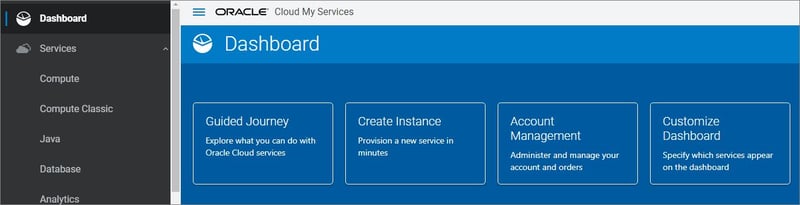
The first thing that isn't overly clear is the fact that for modern (recently created) Oracle Cloud accounts, the Backup Service can be added to the OCI Dashboard but interestingly, it does not appear in the service list. To add, choose Customize Dashboad (rightmost box) and then choose Database Backup from the Data Management section:
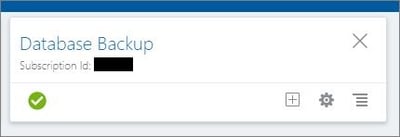
It will then appear on the dashboard and can be selected:
Selecting that service provides some details but not critical information about how it's being used or the REST endpoint URL:
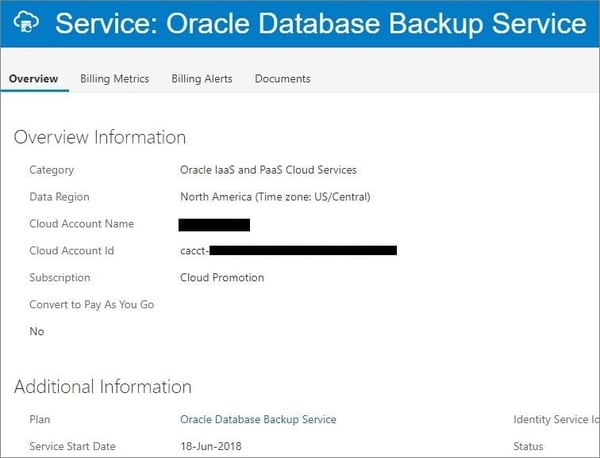
There's other account information not shown in the screenshot, but the critical information needed to start using the service is not displayed. Similarly, most MOS documents and online documentation currently suggest that the REST endpoint is in the format of:
https://myDomain.storage.oraclecloud.com/v1/myService-myDomain However, if your Oracle Cloud account was created recently, it likely will not be in formatted that way and instead, will use a URL that starts with, or includes, a region-specific sub-domain. The trick to finding the actual REST endpoint URL is to recognize that the Database Backup Service still uses Oracle Cloud Classic object storage.
The quick solution: add the region to the REST URL
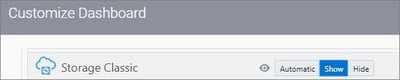
The region is probably pretty easy to guess (i.e. "us" or "em") however to determine the proper URL with accuracy, the easiest thing to do is to determine it from the Classic Storage service dashboard. Again, choose to customize the dashboard and this time, choose to add Storage Classic:
When added to the dashboard, click on the service to open up the "
Service: Oracle Cloud Infrastructure Object Storage Classic" service page. Near the bottom under
Additional Information will be the proper
REST Endpoint and
Auth V1 Endpoint to use. From the top right of the service page, you can also click on the
Open Service Console link to get to the details of the storage usage. Hence, the URL is probably something simple like:
https://myDomain.us.storage.oraclecloud.com/v1/Storage-myDomain
An alternate URL also exists on the Storage Service Console
To make matters a little more confusing, an alternate but still usable URL can be obtained from the storage service page. First, navigate to the Storage Service Console page. Either by choosing the Open Service Console button from the top right (in the blue bar) from the " Service: Oracle Cloud Infrastructure Object Storage Classic" page or by choosing it in the black navigation menu on the left. Under the Account tab, we can see the REST endpoint URL for the Storage Service which also can be used:
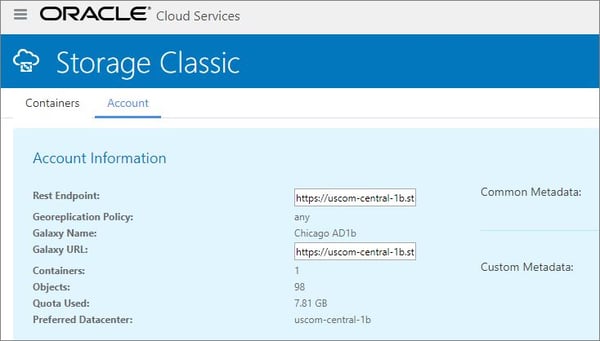
This URL is also one that can be used when installing the
Oracle Database Cloud Backup Module so that RMAN backups can write to the Backup Service.
Creating storage containers
The next challenge is how to create your own storage containers within the service. You may want to create storage containers to logically divide the cloud backups by department, business unit, server, or even database. Creating a container is rather straightforward from the Storage Classic service web page as shown previously - just use the Containers tab. But it's more challenging if you want to use scripted or manual cURL commands and REST. Which may be necessary if you have a large deployment. Oracle provides the MOS document " Step-by-Step procedure to place On-Premise Database backup on Oracle Cloud (Doc ID 2225766.1)" to complement the online documentation. But again the URL format provided does not work for modern Oracle Cloud accounts. To create the required authorization token, the cURL command required is actually:curl -i -X GET https:///auth/v1.0 -H 'X-Storage-User: Storage-:' -H 'X-Storage-Pass: 'The catch here is to use the base URL from your REST endpoint (as determined previously). For example: https://uscom-central-1b.us.storage.oraclecloud.com/auth/v1.0 Example output:
$ curl -i -X GET https://uscom-central-1b.us.storage.oraclecloud.com/auth/v1.0 -H 'X-Storage-User: Storage-*********:simon_pane@********' -H 'X-Storage-Pass: *********'
HTTP/1.1 200 OK
date: 1532712571246
X-Auth-Token: AUTH_tkabf61211e7cfe0a3******************
X-Storage-Token: AUTH_tkabf61211e7cfe0a3******************
X-Storage-Url: https://uscom-central-1b.storage.oraclecloud.com/v1/Storage-*********
Content-Length: 0
Server: Oracle-Storage-Cloud-Service
You can then use the
X-Auth-Token and
X-Storage-Url values returned from the above command to create the desired storage container:
$ curl -v -s -X PUT -H "X-Auth-Token: AUTH_tkabf61211e7cfe0a3******************" https://uslecloud.com/v1/*********/DB_`hostname -s`_${ORACLE_SID}
* About to connect() to uscom-central-1b.storage.oraclecloud.com port 443 (#0)
* Trying 129.150.7.1...
* Connected to uscom-central-1b.storage.oraclecloud.com (129.150.7.1) port 443 (#0)
* Initializing NSS with certpath: sql:/etc/pki/nssdb
* CAfile: /etc/pki/tls/certs/ca-bundle.crt
CApath: none
* SSL connection using TLS_ECDHE_RSA_WITH_AES_128_GCM_SHA256
* Server certificate:
* subject: CN=*.storage.oraclecloud.com,OU=Oracle CSEC CHICAGO,O=Oracle Corporation,L=Redwood City,ST=California,C=US
* start date: Sep 11 00:00:00 2017 GMT
* expire date: Dec 11 23:59:59 2018 GMT
* common name: *.storage.oraclecloud.com
* issuer: CN=Symantec Class 3 Secure Server CA - G4,OU=Symantec Trust Network,O=Symantec Corporation,C=US
> PUT /v1/Storage-*********/DB_oci-12201-vm1_ORCL HTTP/1.1
> User-Agent: curl/7.29.0
> Host: uscom-central-1b.storage.oraclecloud.com
> Accept: */*
> X-Auth-Token: AUTH_tkabf61211e7cfe0a3******************
>
< HTTP/1.1 201 Created
< X-Last-Modified-Timestamp: 1532712939.95273
< X-Trans-Id: txfbe0422b4a5e4fe08f411-***************
< Content-Length: 0
< Date: Fri, 27 Jul 2018 17:35:40 GMT
< Server: Oracle-Storage-Cloud-Service
<
* Connection #0 to host uscom-central-1b.storage.oraclecloud.com left intact
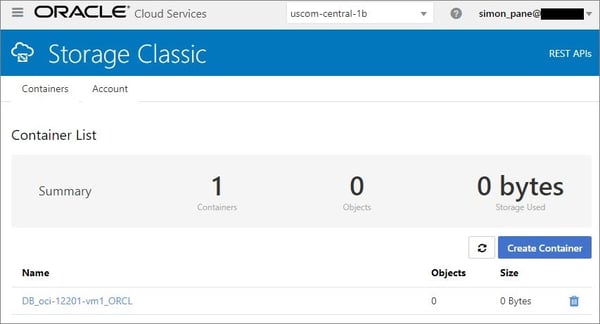
And the new container can be confirmed from the Web UI, if required:
Installing and backing up using the Oracle Database Cloud backup module
Now that the REST endpoint URL has been determined and the storage container created, the rest of the deployment is straightforward and follows the documented procedures. Install using the REST endpoint URL and use the -container option to specify the container to use:$ java -jar opc_install.jar \
> -serviceName Storage \
> -identityDomain ******** \
> -host https://uscom-central-1b.storage.oraclecloud.com/v1/Storage-******** \
> -opcId 'simon_pane@********' \
> -opcPass '********' \
> -walletDir $ORACLE_HOME/dbs/opc${ORACLE_SID} \
> -libDir ${ORACLE_HOME}/lib \
> -container DB_`hostname -s`_${ORACLE_SID}
Oracle Database Cloud Backup Module Install Tool, build 12.2.0.1.0DBBKPCSBP_2018-06-12
Oracle Database Cloud Backup Module credentials are valid.
Backups would be sent to container DB_oci-12201-vm1_ORCL.
Oracle Database Cloud Backup Module wallet created in directory /u01/app/oracle/product/12.2.0.1/dbhome_1/dbs/opcORCL.
Oracle Database Cloud Backup Module initialization file /u01/app/oracle/product/12.2.0.1/dbhome_1/dbs/opcORCL.ora created.
Downloading Oracle Database Cloud Backup Module Software Library from file opc_linux64.zip.
Download complete.
$
Adjust the RMAN settings:
$ echo "configure channel device type sbt parms='SBT_LIBRARY=libopc.so,SBT_PARMS=(OPC_PFILE=${ORACLE_HOME}/dbs/opc${ORACLE_SID}.ora)';" | rman target=/
Recovery Manager: Release 12.2.0.1.0 - Production on Fri Jul 27 19:33:58 2018
Copyright (c) 1982, 2017, Oracle and/or its affiliates. All rights reserved.
connected to target database: ORCL (DBID=1509082029)
RMAN>
using target database control file instead of recovery catalog
new RMAN configuration parameters:
CONFIGURE CHANNEL DEVICE TYPE 'SBT_TAPE' PARMS 'SBT_LIBRARY=libopc.so,SBT_PARMS=(OPC_PFILE=/u01/app/oracle/product/12.2.0.1/dbhome_1/dbs/opcORCL.ora)';
new RMAN configuration parameters are successfully stored
RMAN>
Recovery Manager complete.
$ echo "configure default device type to sbt;" | rman target=/
Recovery Manager: Release 12.2.0.1.0 - Production on Fri Jul 27 19:33:59 2018
Copyright (c) 1982, 2017, Oracle and/or its affiliates. All rights reserved.
connected to target database: ORCL (DBID=1509082029)
RMAN>
using target database control file instead of recovery catalog
new RMAN configuration parameters:
CONFIGURE DEFAULT DEVICE TYPE TO 'SBT_TAPE';
new RMAN configuration parameters are successfully stored
RMAN>
Recovery Manager complete.
$ echo "configure controlfile autobackup on;" | rman target=/
Recovery Manager: Release 12.2.0.1.0 - Production on Fri Jul 27 19:34:00 2018
Copyright (c) 1982, 2017, Oracle and/or its affiliates. All rights reserved.
connected to target database: ORCL (DBID=1509082029)
RMAN>
using target database control file instead of recovery catalog
new RMAN configuration parameters:
CONFIGURE CONTROLFILE AUTOBACKUP ON;
new RMAN configuration parameters are successfully stored
RMAN>
Recovery Manager complete.
$
And finally, run a backup remembering to include backup encryption:
$ read -s BUpassword
$ echo -e "set encryption on identified by \$BUpassword\" only;\nbackup database plus archivelog;"" | rman target=/
Topics:
Google Cloud
Microsoft SQL Server
Cloud Sql
Technical Track
Database
Databases
Google Cloud Sql
Share this
- Technical Track (816)
- Oracle (488)
- Database (229)
- MySQL (144)
- Cloud (133)
- Microsoft SQL Server (124)
- Open Source (84)
- Google Cloud (82)
- Microsoft Azure (67)
- Amazon Web Services (AWS) (63)
- Big Data (50)
- Cassandra (44)
- Google Cloud Platform (44)
- DevOps (38)
- Linux (28)
- Pythian (27)
- PostgreSQL (26)
- Podcasts (25)
- Site Reliability Engineering (23)
- Performance (22)
- Docker (21)
- Oracle E-Business Suite (21)
- DBA (18)
- Oracle Cloud Infrastructure (OCI) (18)
- MongoDB (17)
- Security (17)
- Hadoop (16)
- BigQuery (15)
- Amazon RDS (14)
- Automation (14)
- Exadata (14)
- Oracleebs (14)
- Snowflake (14)
- Ansible (13)
- Oracle Database (13)
- Oracle Exadata (13)
- ASM (12)
- Data (12)
- LLM (12)
- Artificial Intelligence (AI) (11)
- GenAI (11)
- Kubernetes (11)
- Machine Learning (11)
- Advanced Analytics (10)
- Datascape Podcast (10)
- Oracle Applications (10)
- Replication (10)
- Authentication, SSO and MFA (8)
- ChatGPT (8)
- Cloud Migration (8)
- Infrastructure (8)
- Monitoring (8)
- Percona (8)
- Analytics (7)
- Apache (7)
- Apache Cassandra (7)
- Data Governance (7)
- High Availability (7)
- Mariadb (7)
- Microsoft Azure SQL Database (7)
- Myrocks (7)
- Oracle EBS (7)
- Python (7)
- Rman (7)
- SAP (7)
- Series (7)
- AWR (6)
- Airflow (6)
- Apache Beam (6)
- Data Guard (6)
- Innodb (6)
- Migration (6)
- Oracle Enterprise Manager (OEM) (6)
- Orchestrator (6)
- RocksDB (6)
- Azure Synapse Analytics (5)
- Covid-19 (5)
- Data Enablement (5)
- Disaster Recovery (5)
- Microsoft (5)
- Performance Tuning (5)
- Scala (5)
- Serverless (5)
- Cloud Security (4)
- Cloud Spanner (4)
- CockroachDB (4)
- Data Management (4)
- Data Pipeline (4)
- Data Security (4)
- Data Strategy (4)
- Data Visualization (4)
- Databases (4)
- Dataflow (4)
- Generative AI (4)
- Google (4)
- Google BigQuery (4)
- Oracle Autonomous Database (Adb) (4)
- Oracle Cloud (4)
- Oracle Enterprise Manager (4)
- Redhat (4)
- Ssl (4)
- Windows (4)
- Xtrabackup (4)
- Amazon Relational Database Service (Rds) (3)
- Apex (3)
- Cloud Database (3)
- Cloud FinOps (3)
- Data Analytics (3)
- Data Migrations (3)
- Database Migration (3)
- Digital Transformation (3)
- ERP (3)
- Google Chrome (3)
- Google Cloud Sql (3)
- Google Workspace (3)
- Heterogeneous Database Migration (3)
- Oracle Live Sql (3)
- Oracle Rac (3)
- Perl (3)
- Power Bi (3)
- Prometheus (3)
- Remote Teams (3)
- Slob (3)
- Tensorflow (3)
- Terraform (3)
- Amazon Data Migration Service (2)
- Amazon Ec2 (2)
- Anisble (2)
- Apache Flink (2)
- Apache Kafka (2)
- Apexexport (2)
- Ashdump (2)
- Aurora (2)
- Azure Data Factory (2)
- Cloud Armor (2)
- Cloud Data Fusion (2)
- Cloud Hosting (2)
- Cloud Infrastructure (2)
- Cloud Shell (2)
- Cloud Sql (2)
- Conferences (2)
- Cosmos Db (2)
- Cosmosdb (2)
- Cost Management (2)
- Data Discovery (2)
- Data Integration (2)
- Data Quality (2)
- Data Streaming (2)
- Database Administrator (2)
- Database Consulting (2)
- Database Monitoring (2)
- Database Performance (2)
- Database Troubleshooting (2)
- Dataguard (2)
- Dataops (2)
- Enterprise Data Platform (EDP) (2)
- Events (2)
- Fusion Middleware (2)
- Gemini (2)
- Graphite (2)
- Infrastructure As Code (2)
- Innodb Cluster (2)
- Innodb File Structure (2)
- Innodb Group Replication (2)
- Liquibase (2)
- NLP (2)
- Nosql (2)
- Oracle Data Guard (2)
- Oracle Datase (2)
- Oracle Flashback (2)
- Oracle Forms (2)
- Oracle Installation (2)
- Oracle Io Testing (2)
- Podcast (2)
- Rdbms (2)
- Redshift (2)
- Remote DBA (2)
- Remote Sre (2)
- S3 (2)
- Single Sign-On (2)
- Webinars (2)
- X5 (2)
- AI (1)
- Actifio (1)
- Adop (1)
- Advanced Data Services (1)
- Afd (1)
- Alloydb (1)
- Amazon (1)
- Amazon Aurora Backtrack (1)
- Amazon Efs (1)
- Amazon Redshift (1)
- Amazon S3 (1)
- Amazon Sagemaker (1)
- Amazon Vpc Flow Logs (1)
- Analysis (1)
- Analytical Models (1)
- Anthos (1)
- Application Migration (1)
- Ash (1)
- Asmlib (1)
- Atp (1)
- Autonomous (1)
- Awr Data Mining (1)
- Awr Mining (1)
- Azure Data Lake (1)
- Azure Data Lake Analytics (1)
- Azure Data Lake Store (1)
- Azure Data Migration Service (1)
- Azure OpenAI (1)
- Azure Sql Data Warehouse (1)
- Batches In Cassandra (1)
- Business Insights (1)
- Business Intelligence (1)
- Chown (1)
- Chrome Security (1)
- Cloud Browser (1)
- Cloud Build (1)
- Cloud Consulting (1)
- Cloud Cost Optimization (1)
- Cloud Data Warehouse (1)
- Cloud Database Management (1)
- Cloud Dataproc (1)
- Cloud Foundry (1)
- Cloud Networking (1)
- Cloud SQL Replica (1)
- Cloud Scheduler (1)
- Cloud Services (1)
- Cloud Strategies (1)
- Compliance (1)
- Conversational AI (1)
- Cyber Security (1)
- Data Analysis (1)
- Data Analytics Platform (1)
- Data Box (1)
- Data Classification (1)
- Data Cleansing (1)
- Data Encryption (1)
- Data Engineering (1)
- Data Estate (1)
- Data Insights (1)
- Data Integrity (1)
- Data Leader (1)
- Data Lifecycle Management (1)
- Data Lineage (1)
- Data Masking (1)
- Data Mesh (1)
- Data Migration (1)
- Data Migration Assistant (1)
- Data Migration Service (1)
- Data Mining (1)
- Data Monetization (1)
- Data Policy (1)
- Data Profiling (1)
- Data Protection (1)
- Data Retention (1)
- Data Safe (1)
- Data Sheets (1)
- Data Summit (1)
- Data Vault (1)
- Data Warehouse (1)
- Database Consultant (1)
- Database Link (1)
- Database Management (1)
- Database Migrations (1)
- Database Modernization (1)
- Database Provisioning (1)
- Database Provisioning Failed (1)
- Database Replication (1)
- Database Schemas (1)
- Database Upgrade (1)
- Databricks (1)
- Datascape 59 (1)
- DeepSeek (1)
- Docker-Composer (1)
- Duet AI (1)
- Edp (1)
- Etl (1)
- Gcp Compute (1)
- Gcp-Spanner (1)
- Global Analytics (1)
- Google Analytics (1)
- Google Cloud Architecture Framework (1)
- Google Cloud Data Services (1)
- Google Cloud Partner (1)
- Google Cloud Spanner (1)
- Google Cloud VMware Engine (1)
- Google Compute Engine (1)
- Google Dataflow (1)
- Google Datalab (1)
- Google Grab And Go (1)
- Graph Algorithms (1)
- Graph Inferences (1)
- Graph Theory (1)
- GraphQL (1)
- Health Check (1)
- Healthcheck (1)
- Information (1)
- Infrastructure As A Code (1)
- Innobackupex (1)
- Innodb Concurrency (1)
- Innodb Flush Method (1)
- It Industry (1)
- Kubeflow (1)
- LMSYS Chatbot Arena (1)
- Linux Host Monitoring (1)
- Linux Storage Appliance (1)
- Looker (1)
- MMLU (1)
- Managed Services (1)
- Migrate (1)
- Neo4J (1)
- Newsroom (1)
- Nifi (1)
- OPEX (1)
- Odbcs (1)
- Odbs (1)
- On-Premises (1)
- Open Source Database (1)
- Ora-01852 (1)
- Ora-7445 (1)
- Oracle Cursor (1)
- Oracle Database@Google Cloud (1)
- Oracle Exadata Smart Scan (1)
- Oracle Licensing (1)
- Oracle Linux Virtualization Manager (1)
- Oracle Oda (1)
- Oracle Openworld (1)
- Oracle Parallelism (1)
- Oracle RMAN (1)
- Oracle Rdbms (1)
- Oracle Real Application Clusters (1)
- Oracle Reports (1)
- Oracle Security (1)
- Perfomrance (1)
- Performance Schema (1)
- Policy (1)
- Prompt Engineering (1)
- Public Cloud (1)
- Pythian News (1)
- Rdb (1)
- Replication Error (1)
- Retail (1)
- SAP HANA Cloud (1)
- Securing Sql Server (1)
- Serverless Computing (1)
- Sso (1)
- Tenserflow (1)
- Teradata (1)
- Vertex AI (1)
- Videos (1)
- Workspace Security (1)
- Xbstream (1)
- August 2025 (1)
- July 2025 (3)
- June 2025 (1)
- May 2025 (3)
- March 2025 (2)
- February 2025 (1)
- January 2025 (2)
- December 2024 (1)
- October 2024 (2)
- September 2024 (7)
- August 2024 (4)
- July 2024 (2)
- June 2024 (6)
- May 2024 (3)
- April 2024 (2)
- February 2024 (1)
- January 2024 (11)
- December 2023 (10)
- November 2023 (9)
- October 2023 (11)
- September 2023 (9)
- August 2023 (6)
- July 2023 (2)
- June 2023 (13)
- May 2023 (4)
- April 2023 (6)
- March 2023 (10)
- February 2023 (6)
- January 2023 (5)
- December 2022 (10)
- November 2022 (10)
- October 2022 (10)
- September 2022 (13)
- August 2022 (16)
- July 2022 (12)
- June 2022 (13)
- May 2022 (11)
- April 2022 (4)
- March 2022 (5)
- February 2022 (4)
- January 2022 (14)
- December 2021 (16)
- November 2021 (11)
- October 2021 (6)
- September 2021 (11)
- August 2021 (6)
- July 2021 (9)
- June 2021 (4)
- May 2021 (8)
- April 2021 (16)
- March 2021 (16)
- February 2021 (6)
- January 2021 (12)
- December 2020 (12)
- November 2020 (17)
- October 2020 (11)
- September 2020 (10)
- August 2020 (11)
- July 2020 (13)
- June 2020 (6)
- May 2020 (9)
- April 2020 (18)
- March 2020 (21)
- February 2020 (13)
- January 2020 (15)
- December 2019 (10)
- November 2019 (11)
- October 2019 (12)
- September 2019 (16)
- August 2019 (15)
- July 2019 (10)
- June 2019 (16)
- May 2019 (20)
- April 2019 (21)
- March 2019 (14)
- February 2019 (18)
- January 2019 (18)
- December 2018 (5)
- November 2018 (16)
- October 2018 (12)
- September 2018 (20)
- August 2018 (27)
- July 2018 (31)
- June 2018 (34)
- May 2018 (28)
- April 2018 (27)
- March 2018 (17)
- February 2018 (8)
- January 2018 (20)
- December 2017 (14)
- November 2017 (4)
- October 2017 (1)
- September 2017 (3)
- August 2017 (5)
- July 2017 (4)
- June 2017 (2)
- May 2017 (7)
- April 2017 (7)
- March 2017 (8)
- February 2017 (8)
- January 2017 (5)
- December 2016 (3)
- November 2016 (4)
- October 2016 (8)
- September 2016 (9)
- August 2016 (10)
- July 2016 (9)
- June 2016 (8)
- May 2016 (13)
- April 2016 (16)
- March 2016 (13)
- February 2016 (11)
- January 2016 (6)
- December 2015 (11)
- November 2015 (11)
- October 2015 (5)
- September 2015 (16)
- August 2015 (4)
- July 2015 (1)
- June 2015 (3)
- May 2015 (6)
- April 2015 (5)
- March 2015 (5)
- February 2015 (4)
- January 2015 (3)
- December 2014 (7)
- October 2014 (4)
- September 2014 (6)
- August 2014 (6)
- July 2014 (16)
- June 2014 (7)
- May 2014 (6)
- April 2014 (5)
- March 2014 (4)
- February 2014 (10)
- January 2014 (6)
- December 2013 (8)
- November 2013 (12)
- October 2013 (9)
- September 2013 (6)
- August 2013 (7)
- July 2013 (9)
- June 2013 (7)
- May 2013 (7)
- April 2013 (4)
- March 2013 (7)
- February 2013 (4)
- January 2013 (4)
- December 2012 (6)
- November 2012 (8)
- October 2012 (9)
- September 2012 (3)
- August 2012 (5)
- July 2012 (5)
- June 2012 (7)
- May 2012 (11)
- April 2012 (1)
- March 2012 (8)
- February 2012 (1)
- January 2012 (6)
- December 2011 (8)
- November 2011 (5)
- October 2011 (9)
- September 2011 (6)
- August 2011 (4)
- July 2011 (1)
- June 2011 (1)
- May 2011 (5)
- April 2011 (2)
- February 2011 (2)
- January 2011 (2)
- December 2010 (1)
- November 2010 (7)
- October 2010 (3)
- September 2010 (8)
- August 2010 (2)
- July 2010 (4)
- June 2010 (7)
- May 2010 (2)
- April 2010 (1)
- March 2010 (3)
- February 2010 (3)
- January 2010 (2)
- November 2009 (6)
- October 2009 (6)
- August 2009 (3)
- July 2009 (3)
- June 2009 (3)
- May 2009 (2)
- April 2009 (8)
- March 2009 (6)
- February 2009 (4)
- January 2009 (3)
- November 2008 (3)
- October 2008 (7)
- September 2008 (6)
- August 2008 (9)
- July 2008 (9)
- June 2008 (9)
- May 2008 (9)
- April 2008 (8)
- March 2008 (4)
- February 2008 (3)
- January 2008 (3)
- December 2007 (2)
- November 2007 (7)
- October 2007 (1)
- August 2007 (4)
- July 2007 (3)
- June 2007 (8)
- May 2007 (4)
- April 2007 (2)
- March 2007 (2)
- February 2007 (5)
- January 2007 (8)
- December 2006 (1)
- November 2006 (3)
- October 2006 (4)
- September 2006 (3)
- July 2006 (1)
- May 2006 (2)
- April 2006 (1)
- July 2005 (1)
No Comments Yet
Let us know what you think