


Retailer automated inventory processing with AI
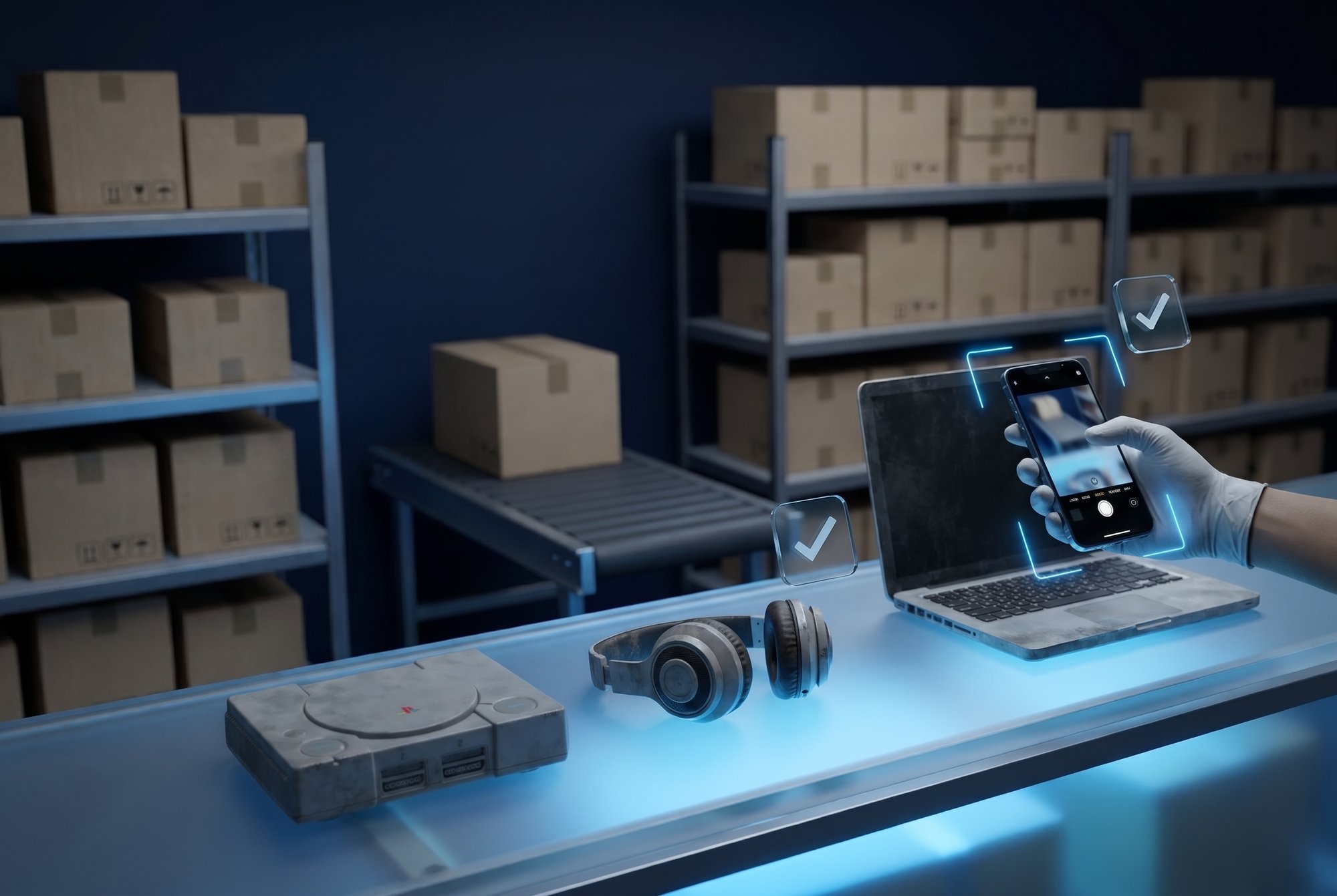
Accelerated warehouse receiving with mobile scanning while ensuring precise SKU matching.
Pythian accelerated warehouse inventory processing and improved product catalog accuracy for the US-based retailer.
Processing 30,000 trade-ins a month was creating major delays for a specialty retailer. Their existing image tools couldn't spot minor differences between product models—and could not process images with cluttered or busy backgrounds. Staff had to spend up to 10 minutes logging each item manually.
Pythian fixed the bottleneck with a custom AI scanning tool built in Google Cloud. By training the system on realistic, computer-generated product images, staff can now identify and log gear in under a second using a mobile device. Eliminating manual data entry dramatically sped up warehouse inventory processing resulting in employees being able to spend more time helping customers on their retail floor.
We took the 10-minute verification process down to seconds. Our customers just scan the merchandise with their phone and we know it’s accurate."
Chief Technology Officer
Specialty Retailer
10x
Increase in real-world identification accuracy
70%
Reduction in manual inventory processing time
30K
Monthly customer trade-ins verified automatically




Warehouse inventory processing created a backlog, impacting the customer experience.
The retailer offers a trade-in program, and with great success they saw an increase in products being digitally uploaded. They needed an easy way to scan in products in seconds and automatically identify and tag inventory with complete accuracy.
Pythian brought the cloud and data engineering expertise we needed to transform a time-consuming manual check into a highly accurate, automated process that dramatically improves our operational velocity.”
Chief Technology Officer
Specialty Retailer
Model threshold limits created catalog blind spots
The existing 5,000-category model threshold failed to identify newer product generations, causing verification failures on newly released hardware models traded in by consumers.
Manual processing delayed time-to-resale
Receiving 30,000 units monthly overwhelmed floor staff, freezing used assets in the inspection queue instead of listing them onto the active e-commerce site.
Background noise corrupted recognition
The initial application required strict, all-white backgrounds to function, causing image recognition algorithms to fail completely when consumers snapped photos over real-world settings like carpets, house walls, or garage floors.
Manual field data entry increased abandonment
Application identification failures forced users to manually input brand, configuration, and condition metrics, causing customers to leave sessions incomplete.
Computer vision automated inventory processing and warehouse receiving
- 01 Synthetic data generation
- 02 Multimodal SKU matching
- 03 Warehouse receiving automation
- 04 AIOps
Pythian engineered data pipelines to eliminate trade-in product background noise and solve photo shortages.
Customer trade-in photos taken against noisy backgrounds were rejected. The trade-in program required pure white backgrounds, forcing tedious manual typing and driving trade-in abandonment. Compounding the issue, the retailer lacked reference photos for tens of thousands of older product models. To solve both problems without expensive studio photography, Pythian built synthetic data pipelines in Google Cloud that generated photorealistic 3D models across diverse lighting, angles, and background clutter. This trained the vision models to instantly identify items in any real-world environment on the first try, eliminating manual data entry and friction for customers.
Technical teams fine-tuned multimodal Gemini models to achieve sub-second SKU matching and condition grading.
Pythian deployed multi-tiered visual classification models using Google Cloud Gemini and Vertex AI Vector Search. By tuning Gemini’s multimodal vision capabilities, the system autonomously analyzes subtle generation markers, groove patterns, manufacturer stamps, and physical wear. The engine cross-references visual embeddings against the retailer's master product catalog, delivering high-confidence SKU matching and condition scoring in milliseconds.
Pythian deployed a mobile scan solution to speed up warehouse inventory receiving and processing to get items listed faster.
Pythian integrated the Gemini vision pipeline directly into floor associates' handheld mobile scanning devices and the warehouse management system (WMS). When a trade-in shipment arrives, warehouse staff take a single photo with a mobile device. The system instantly verifies the exact SKU, assesses its cosmetic condition, updates inventory balances, and generates the active e-commerce listing immediately.
Pythian ensured a seamless technical transfer, delivering clear governance processes to ensure operational autonomy.
Pythian embedded production-ready technical architectures, automated CI/CD pipelines, and continuous model drift monitoring directly into the retailer's internal developer repositories. Hands-on knowledge transfer and technical workshops empowered internal engineering teams to maintain, govern, and scale their updated Gemini pipeline and future catalog categories autonomously.


