


2025 employee survey on the use of AI
In November 2025, Pythian, a professional services firm specialized in data, analytics and AI, commissioned Sirkin Research to conduct a survey that explores how employees are using AI in the workplace, how they feel about using AI, and the most frequent use cases of AI. The survey also explores the comparison of AI use cases for Google Gemini and Microsoft Copilot as these are the most common workplace productivity tools with embedded AI.
So what did the survey, delivered to thousands of employees, in the United States across a variety of industries including retail, manufacturing, education, business services and technology (to name a few) uncover?
You might be surprised at how well AI is being adopted in the workplace and the reasons why.
Key finding #1: Employees using AI are saving 8.1 hours per week
Assuming a 40 hour workweek with 50 workweeks in a year, this implies an annualized productivity gain of up to 20% - or 10 weeks/year.
Key finding #2: 87% of workers view AI positively
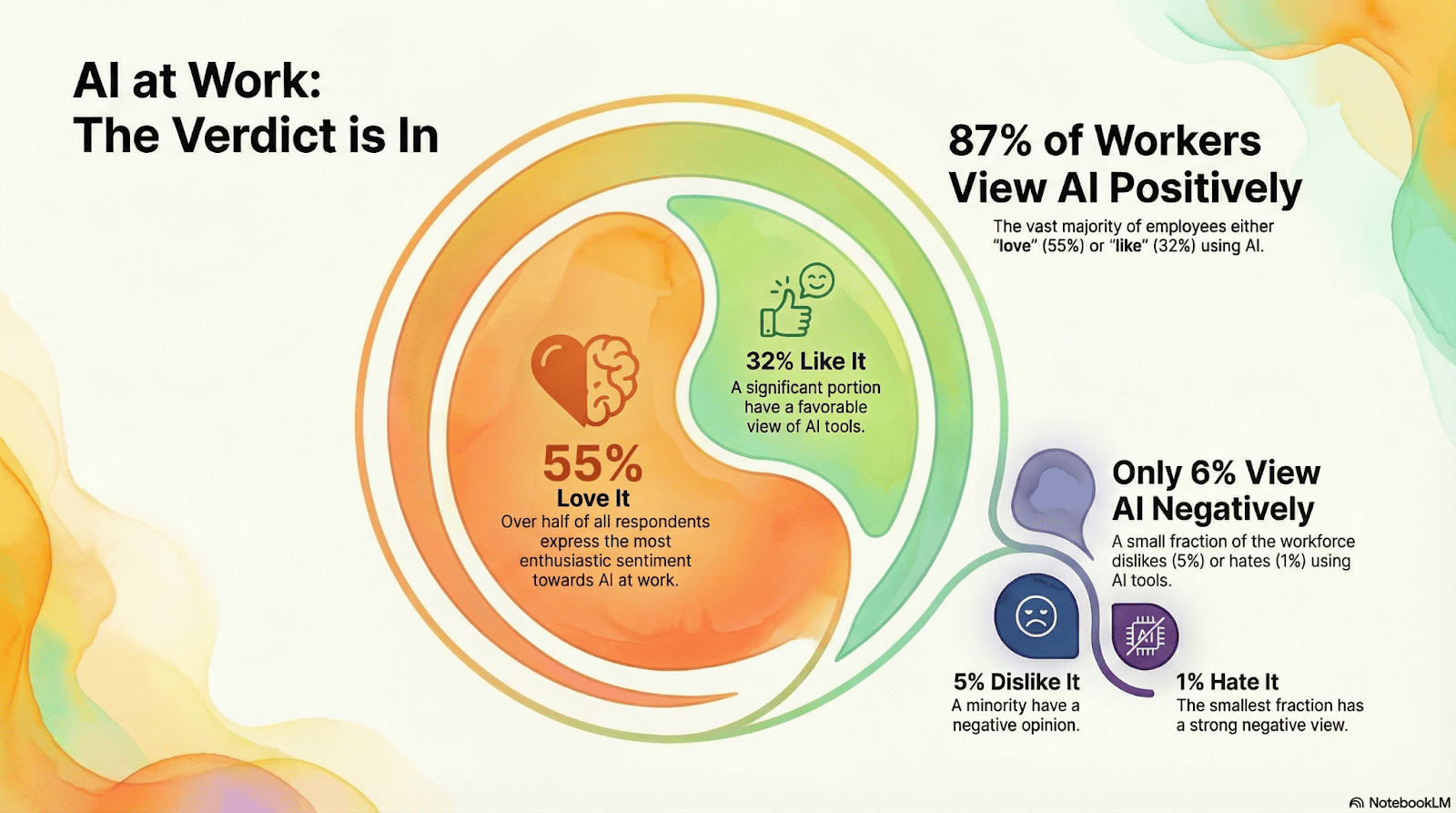
Not surprising, given the productivity boost for employees, the vast majority of workers (87%) view AI positivity. 55% noted they “love it” with another 32% stating they “like it”. Only 6% viewed AI negatively with 5% stating they “dislike it” and only 1% stating they “hated it.”
How employees feel about using AI in the workplace infographic:
Key finding #3: Employees find some tasks are more beneficial than others when it comes to using AI
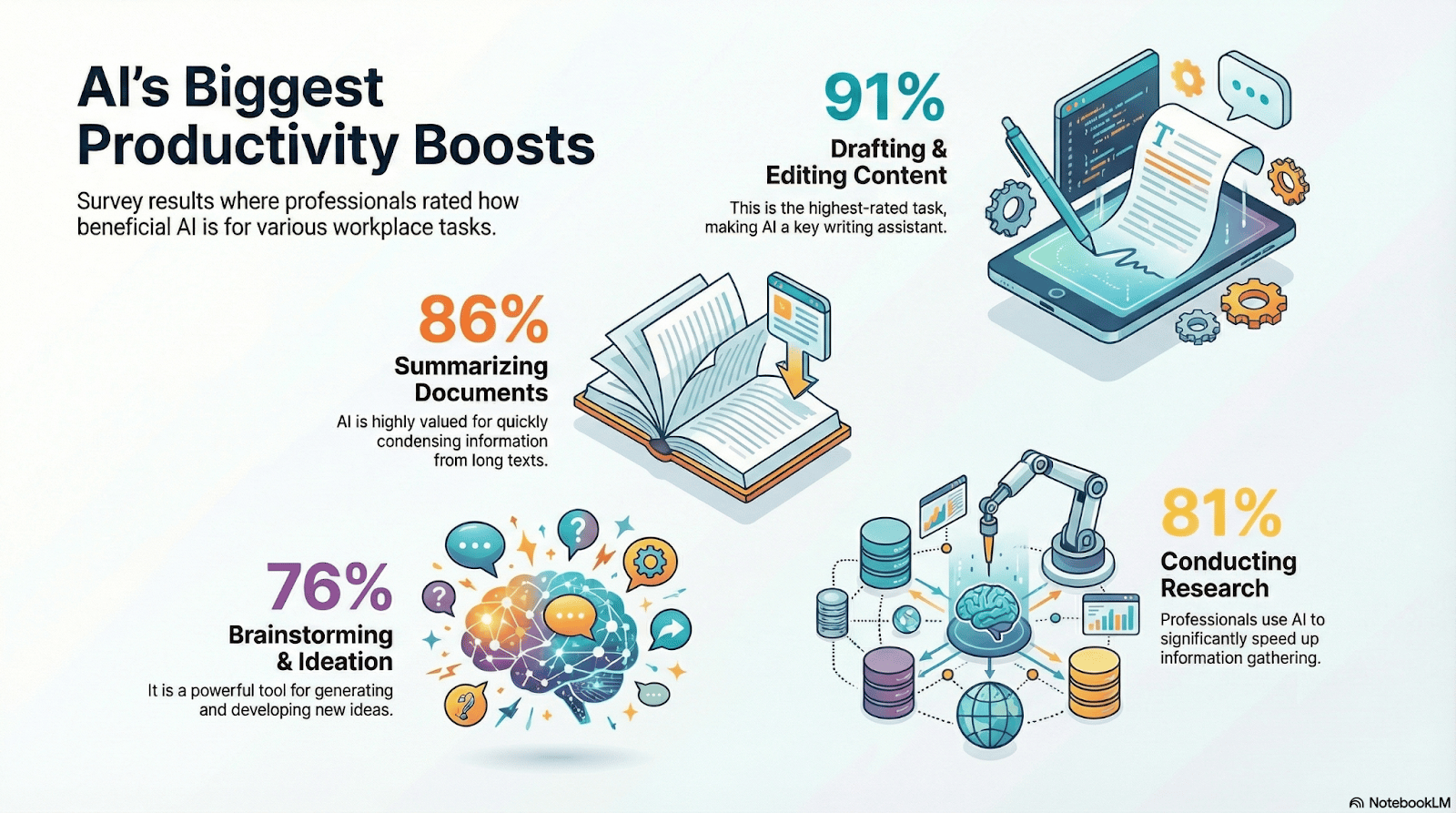
Survey respondents indicated that AI’s biggest productivity boosts were drafting and editing content (91%), summarizing documents (86%), conducting research (81%), and brainstorming and ideation (76%).
Where employees didn’t find AI as beneficial were data entry and processing, creating/editing images/videos, and scheduling calendar events.
AI’s biggest productivity boosts by tasks infographic:
Most beneficial AI tasks:
| Most Beneficial AI Tasks | Percentage of Respondents* |
| Drafting and editing content | 91% |
| Summarizing documents | 86% |
| Conducting research | 81% |
| Brainstorming and ideation | 76% |
| Taking notes | 64% |
| Finding documents | 54% |
| Analyzing data/reports | 53% |
| Creating/editing slide decks | 42% |
| Data entry and processing | 35% |
| Creating/editing images/videos | 32% |
| Scheduling calendar events | 26% |
* % of respondents who stated “Very Beneficial” or “Beneficial” - 5-point Likert scale
Key finding #4: How frequently employees use AI depends on the use case
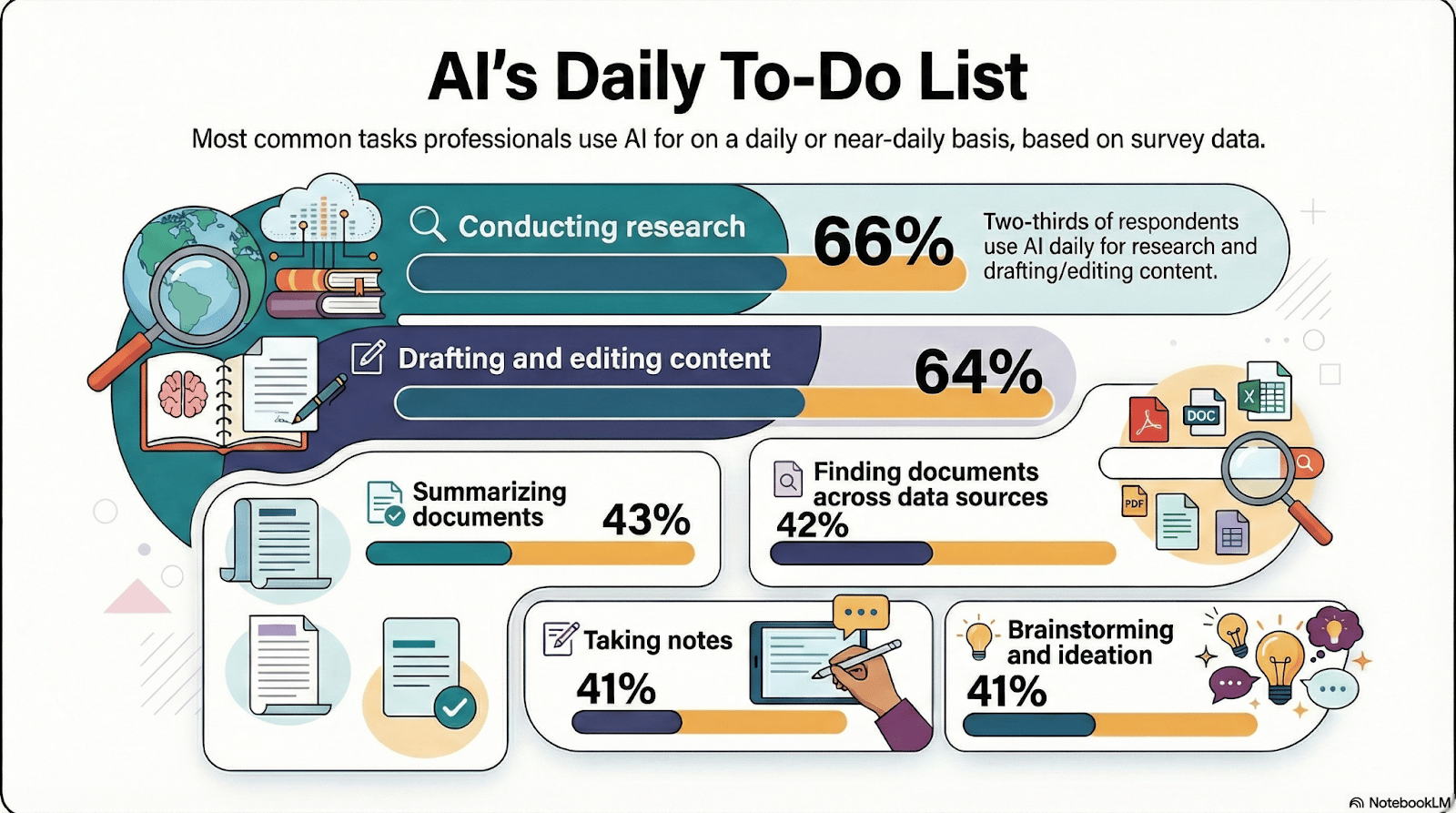
The top use cases for AI included conducting research (66%) and drafting and editing content (64%).
Other frequent tasks, all with a frequency of 41% or more, include finding documents, taking notes, and brainstorming. The least frequent tasks listed are creating or editing slide decks (19%), creating or editing images or videos (12%), and scheduling calendar events (8%).
Most common tasks professionals use AI for infographic:
Most frequent AI tasks:
| Most Frequent AI Tasks | Frequency* |
| Conducting research | 66% |
| Drafting and editing content | 64% |
| Summarizing documents | 43% |
| Finding documents across data sources | 42% |
| Taking notes | 41% |
| Brainstorming and ideation | 41% |
| Data entry and processing | 22% |
| Analyzing spreadsheets or reports | 22% |
| Creating or editing slide decks | 19% |
| Creating or editing images or videos | 12% |
| Scheduling calendar events | 8% |
*% of respondents who say “Daily” or “Almost Daily”
Key finding #5: Google Gemini and Microsoft Copilot, comparatively, are perceived to have different use case strengths and weaknesses
Given the popularity of Google Gemini and Microsoft Copilot embedded AI workplace productivity tools, the survey examined perceived relative strengths and weaknesses of each.
When asked: How do you feel about using AI for work? There were modest differences between Gemini and Copilot, with a slight edge to Google Gemini:
- 92% of respondents who use Google Gemini most often respond with either that they “Love it” or “Like it.”
- 88% of respondents who use Microsoft Copilot most often respond with either that they “Love it” or “Like it.”
However, the survey revealed that there were, in fact, perceived differences in benefits depending on the use case.
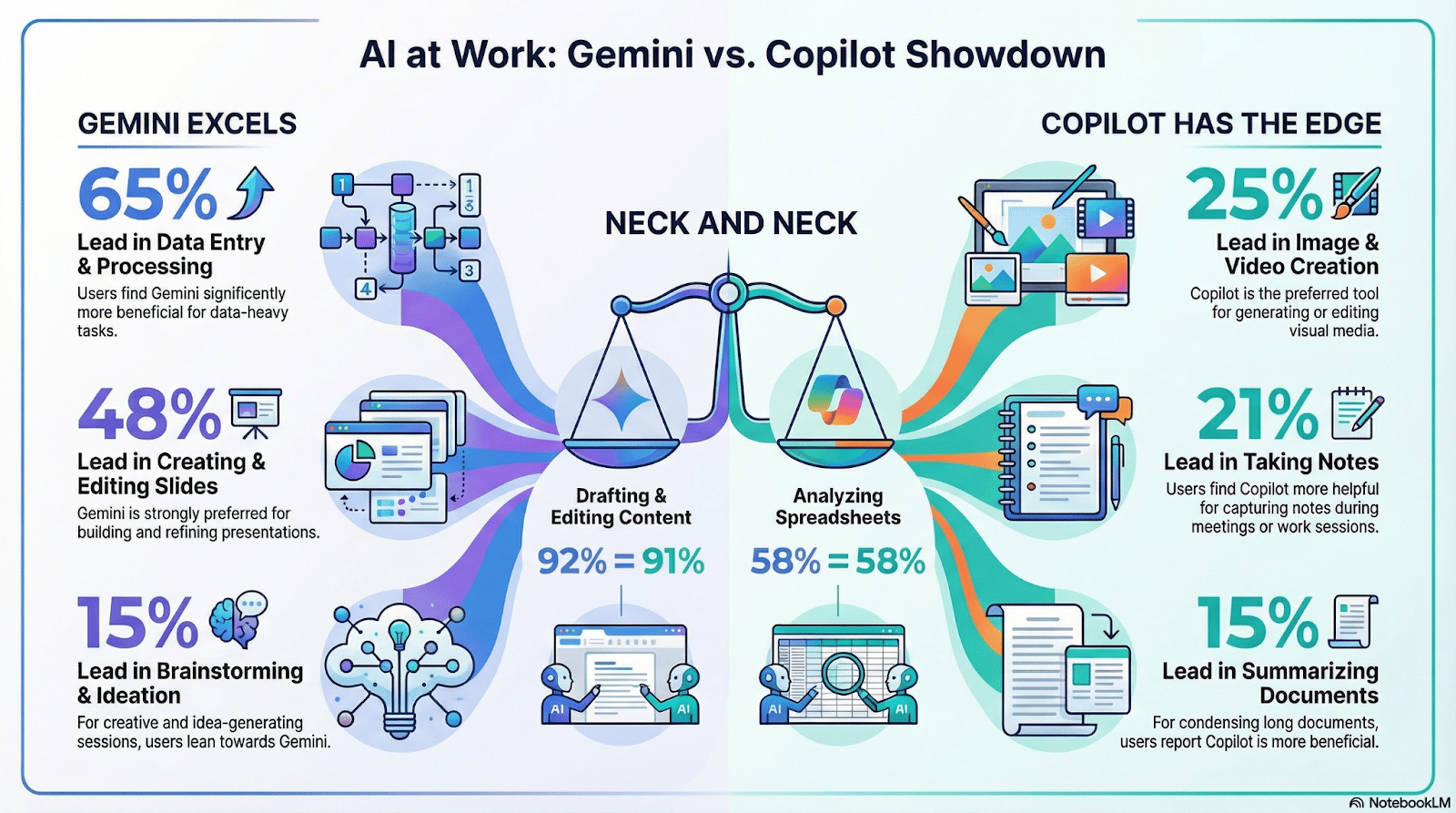
Google Gemini was perceived to excel at:
- Creating or editing slide decks
- Data entry and processing
- Brainstorming and ideation
On the other hand, Microsoft Copilot was perceived better at:
- Creating or editing images or videos
- Taking notes
- Summarizing documents
AI at work: Gemini vs. Copilot showdown infographic:
How beneficial is AI for completing each of the following work tasks?
| Task | Gemini (%)* | Copilot (%)* | Difference (%) |
| Tasks where Gemini holds an advantage | |||
| Data entry and processing | 50 | 30 | 65 |
| Creating or editing slide decks | 58 | 39 | 48 |
| Brainstorming and ideation | 83 | 73 | 15 |
| Drafting and editing content | 92 | 91 | 1 |
| Analyzing spreadsheets or reports | 58 | 58 | 1 |
| Tasks where Copilot holds an advantage | |||
| Conducting research | 75 | 82 | -8 |
| Scheduling calendar events | 25 | 27 | -8 |
| Finding documents across data sources | 50 | 58 | -13 |
| Summarizing documents | 75 | 88 | -15 |
| Taking notes | 50 | 64 | -21 |
| Creating or editing images or videos | 25 | 33 | -25 |
*% of respondents who say “Very Beneficial” or “Beneficial”
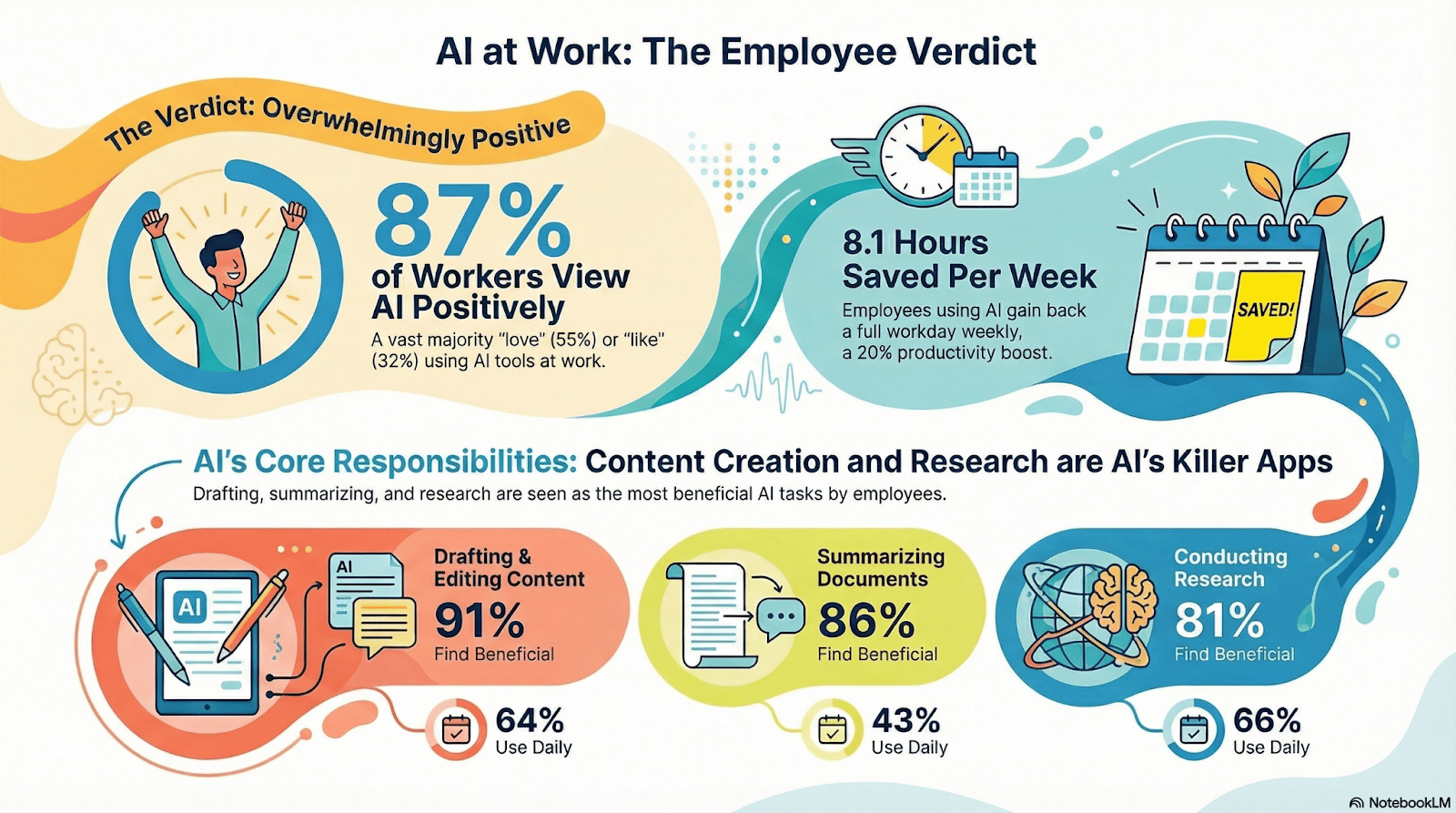
AI at work - the employee verdict
The verdict is overwhelmingly positive with 87% perceiving AI positively, and employees are reclaiming up to a full workday each week - a 20% increase. These AI tools are supporting drafting and editing content, summarizing documents, and conducting research. In fact, the survey findings suggest that at least 64% of employees use AI for drafting, editing, and conducting research daily. With another 43% using AI for summarizing documents.
Both Gemini and Copilot are the dominant embedded AI workplace tools. Each is perceived to have their own strengths and weaknesses based on use cases, with drafting and editing content, and analyzing spreadsheets to be about the same.
AI at work - the employee verdict infographic:
The survey was commissioned by Pythian; and created, conducted, and analyzed by Sirkin Research to minimize any biases.
About Sirkin Research:
Sirkin Research is a B2B demand research firm that specializes in conducting surveys to create actionable insights for content, positioning, and go-to-market strategies. Founded in 2018 and based in Philadelphia, the firm's core process involves surveying to gather data, which is then analyzed to inform content creation, messaging, and product development.
Share this
Share this

3 Ways Gemini in Google Workspace Can Help Improve Workplace Productivity

HR Heroes: Simplifying People Management with Gemini


.svg)
.svg)