


Legacy on-premises Oracle database environments face a critical inflection point. Multi-year server acquisition cycles, perpetual licensing fees, and physical hardware maintenance drain CapEx budgets and severely constrain business agility. Running mission-critical database estates on rigid infrastructure slows execution velocity as transaction volumes grow and demand for real-time operational analytics escalates.
Modernizing these environments by migrating to Oracle Cloud Infrastructure (OCI), Amazon Web Services (AWS), Microsoft Azure, or Google Cloud enables enterprise IT leaders to transition to an elastic, consumption-based operational model—all while maintaining continuous system availability and enterprise-grade security.
Target architectures
Selecting the optimal target cloud platform for enterprise Oracle database workloads requires balancing raw compute performance, licensing flexibility, and operational integration across your existing cloud ecosystem.
Oracle Cloud Infrastructure (OCI)
- Native Database Optimization: OCI serves as the optimized native platform for specialized engineered systems, including OCI Exadata Database Service (ExaCS) and Oracle Autonomous Database. OCI delivers exceptional IOPS, low latency, and native support for multi-tenant Real Application Clusters (RAC) architectures.
- Predictable Cost Efficiency: OCI offers lower baseline costs for high-performance compute, bare-metal instances, and outbound network data transfer (egress) compared to conventional hyperscalers.
- Licensing Efficiency: Oracle’s Bring Your Own License (BYOL) framework maximizes cost efficiency on OCI, making it substantially cheaper to run core enterprise applications (ERP, E-Business Suite, Siebel) natively.
Multi-cloud and strategic hyperscaler deployments
Enterprises can modernize on OCI alongside major public cloud providers to capitalize on OCI's database strengths without abandoning existing investments in AWS, Azure, or Google Cloud:
- Microsoft Azure: Through Oracle Database@Azure, enterprises can run Exadata infrastructure directly inside Azure datacenters, co-locating high-throughput database engines alongside Azure application frameworks with sub-millisecond network latency.
- Google Cloud: Oracle Database@Google Cloud enables organizations to pair low-latency Oracle transactional databases directly with high-concurrency analytics platforms like BigQuery and Vertex AI frameworks.
- Amazon Web Services (AWS): Offers versatile deployment paths via Amazon RDS for Oracle or custom EC2 environments, providing direct integration with AWS-native DataOps tools, serverless architectures, and Redshift data warehouses.
How to transition from rigid hardware refreshes to pay-per-use models
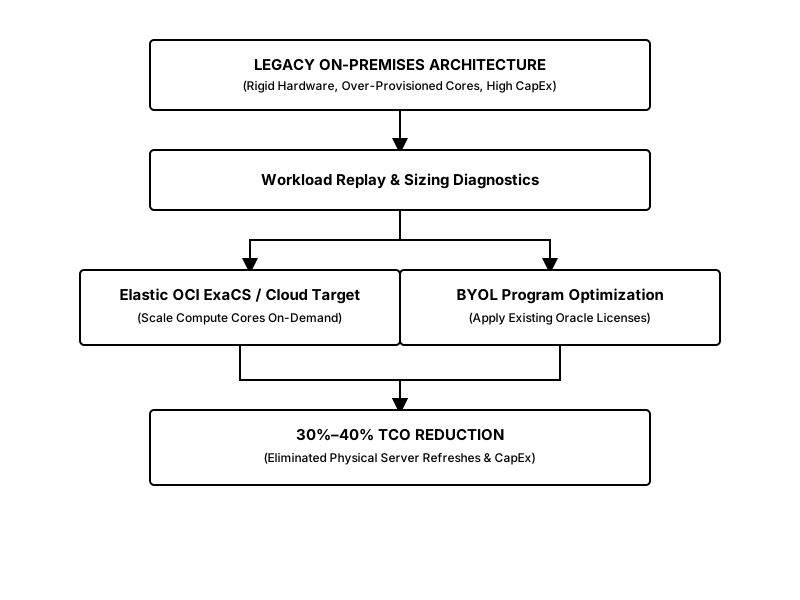
Historical on-premises environments are almost universally over-provisioned to accommodate potential seasonal traffic spikes, leaving expensive compute cores idle during standard operational hours. Transitioning to an elastic cloud foundation grounds infrastructure spend directly in actual usage metrics.
1. Execute workload replay testing to capture true operational footprints
Legacy sizing estimates often reflect administrative safety buffers rather than true resource demand. By conducting pre-migration diagnostic checks and workload replay testing, cloud architects measure real-time peak transaction periods, I/O throughput requirements, and memory allocations. Capturing this empirical baseline prevents over-provisioning and ensures target cloud specifications match true performance needs.
2. Right-size target cloud infrastructure on elastic architectures
Migrating workloads to environments like OCI Exadata Cloud Service (ExaCS) or multi-cloud database services shifts management from fixed hardware acquisition to dynamic resource scaling. Compute cores auto-scale dynamically during traffic bursts, allowing organizations to pay strictly for active usage while eliminating idle server overhead during off-peak hours.
3. Maximize software investments via BYOL optimization
Cloud migration does not require repurchasing software entitlements. Utilizing Bring Your Own License (BYOL) programs across OCI, AWS, Azure, and Google Cloud enables enterprises to transfer existing on-premises database licenses directly to cloud instances, immediately slashing software overhead and preventing double licensing costs, as highlighted in the Oracle and Google Cloud announcement.
4. Lower TCO by 30%–40% and eliminate physical server refreshes
Combining workload right-sizing with BYOL optimization permanently eliminates multi-year CapEx server refresh cycles. Shifting to a predictable OpEx consumption model reduces total cost of ownership (TCO) by 30%–40% while freeing internal database administrators to focus on strategic data engineering initiatives.
Key benefits of Oracle cloud migration services
Modernizing enterprise database estates replaces high-maintenance hardware with a flexible, secure foundation designed for real-time analytics and production AI workloads:
- Eliminate capital expenditures: Transition from multi-year server acquisition cycles to a dynamic, usage-based cloud consumption model.
- Maintain continuous operational availability: Utilize background replication tools like Oracle GoldenGate to continuously synchronize data, keeping transactional systems online throughout the migration.
- Unify data silos for real-time analytics: Stream structured operational data directly into cloud data warehouses, real-time BI tools, and modern MLOps pipelines without overnight ETL delay.
- Maximize existing license value: Apply existing perpetual database licenses toward cloud instances using BYOL across OCI and partner cloud ecosystems.
Evaluating migration partners for continuous availability
Transitioning production databases to the cloud carries non-negotiable operational risks. Extended cutover windows, transactional data loss, or post-migration performance degradation can derail core business operations. When evaluating an enterprise Oracle Database Migration partner, insist on four core capabilities:
- Automated background replication: Deploy continuous, real-time replication pipelines using tools like Oracle GoldenGate and Zero Downtime Migration (ZDM) to ensure core transactional systems remain 100% online throughout the transition.
- Zero data loss & sub-minute cutovers: Engineer high-availability, multi-region failover configurations into the target cloud architecture, validating zero-data-loss guarantees through dry-run cutover rehearsals.
- Certified Oracle ACE expertise: Engage certified Oracle ACEs and Principal Database Consultants who bring decades of hands-on technical architecture and execution experience to minimize project risk.
- 24/7 managed operations and optimization: Partner with database architects who provide end-to-end schema refactoring, performance tuning, and continuous post-migration 24/7 DBA managed services.
How Pythian executes zero-downtime Oracle migrations
Executing enterprise migrations without business interruption requires a structured, multi-phase methodology. Pythian acts as an active extension of your team across five technical phases:
- Technical assessment and workload discovery: Map application dependencies, inventory database estates, and evaluate source-to-target schema compatibility.
- Data strategy, governance and foundations: Establish secure landing zones, define data governance policies, and configure multi-region high-availability failover architectures.
- Target infrastructure provisioning: Right-size target compute nodes and storage tiers across OCI Exadata, private cloud, or hyperscaler platforms (AWS, Azure, Google Cloud).
- Automated deployment & cutover execution: Perform schema conversions, establish real-time Oracle GoldenGate replication pipelines, and run workload replay tests to achieve sub-minute cutovers with zero data loss.
- Post-migration optimization & Managed Services: Conduct health checks, tune query performance, and provide continuous 24/7 DBA Managed Services to ensure optimal operational health.
Modernize your enterprise Oracle data foundation
Migrating off legacy on-premises hardware replaces operational friction with high-velocity data availability. By establishing low-latency replication pipelines and right-sizing target cloud infrastructure, enterprise architectures gain the agility to feed real-time BI dashboards and power production-ready AI frameworks without operational interruption.
Share this
Share this

Why to Work with Certified Oracle ACE Consultants

The Best Oracle Consulting Firms: How to Choose an Oracle Consulting Partner