



Every week, another vendor announces an “always-on, fully autonomous AI agent” designed to take over manual tasks. These persistent AI agents are a new, evolving agent type—systems that retain state, work in the background across applications after you log off, and only ping you when they need approval or a decision.
The demos are unquestionably impressive. But as someone who spends every day sitting down with CIOs, CTOs, and enterprise leaders, I can tell you where the real conversation is happening:
Vendors are racing to sell you persistent agent licenses. But software alone won't solve the problem. What enterprises actually need is an AI operating model that makes persistent agents trustworthy, scalable enterprise workers.
What is a persistent AI agent?
Let's strip away the buzzwords and define what a persistent agent is, and what it is not. A prompt wrapper connected to a database isn't a persistent enterprise agent.
The definition of persistent AI agent
per·sis·tent AI a·gent
noun
A persistent AI agent is an autonomous software system designed to retain memory, task state, and identity across sessions, enabling it to execute multi-step workflows in the background without active user connection and request intervention only for necessary decisions or approvals.
What characteristics define a persistent AI agent?
To operate inside a modern business, an agent requires:
 Durable memory and task state |
The ability to execute long-running workflows across hours or days without losing context. |
 Scoped identity and authorization |
Operating under a clear user, role, or departmental identity with strict role-based access controls |
 Bounded authority |
Hardcoded escalation rules that mandate human approval for financial, legal, customer, or operational decisions. |
 Full auditability and observability (AgentOps) |
Comprehensive logging so security and compliance teams can reconstruct every decision, tool call, and data access event. |
 Cost and value governance |
Clear limits on token consumption, API calls, and execution retries to guarantee measurable ROI over seat licenses. |
If your agent lacks these controls, it isn't an enterprise asset—it's an unmonitored operational risk.
When to use persistent AI agents?
The layered work pattern: Stop trying to replace everything
A common misconception among IT executives is that persistent agents will instantly replace copilots, existing workflows, and core ERP or CRM systems. They won't. Persistent agents are an additive before they are a substitute.
In a mature enterprise architecture, agents sit above your existing systems of record and workflow engines to coordinate complex tasks across applications:
- Questions, drafting, and research: Best served by chat and conventional copilots.
- Single-app repeated tasks: Handled by embedded application copilots.
- Deterministic, high-volume transactions: Best executed by conventional automation engines (RPA/BPM). Do not use an AI agent where a simple rule-based script is cheaper, faster, and easier to audit.
- Cross-system work with context, ambiguity, and exceptions: This is the sweet spot for persistent agents.
The journey to agent-first execution follows four distinct phases:
Augment -> Orchestrate -> Own bounded workflow -> Agent-first
Only a fraction of enterprise workflows will, or should, reach the "Agent-First" stage.
Automation framework: Conduct a workflow placement exercise to determine the need for persistent AI agents
Before giving an agent standing access to your infrastructure, evaluate the candidate workflow across six core dimensions:
|
Dimension |
Low score |
High score |
Why it matters |
|---|---|---|---|
|
Variability and context |
Stable, rules-based work |
Ambiguous work requiring context and judgment |
Persistent agents earn their complexity when the workflow cannot be fully codified |
|
Cross-system breadth |
One application or database |
Several applications, documents, and communication channels |
Agents are most useful when coordination is the problem |
|
Exception rate |
Few exceptions |
Frequent exceptions and escalations |
High exception rates favor an agent with judgment, but only with clear approval boundaries |
|
Business consequence |
Low-impact and reversible |
Financial, regulatory, customer, or people impact |
Higher consequence requires stronger controls and more human involvement |
|
Data and process readiness |
Clean data and documented process |
Fragmented data and undocumented workarounds |
Poor foundations may require data/process remediation before agent deployment |
|
Need for continuity |
One-off interaction |
Work that continues across hours, days, or events |
Persistence matters when the task must survive user disconnection and resume with context |
Decision rules: Define the need for persistent AI agents to automate workflows
|
Workflow profile |
Recommended pattern |
Rationale |
|---|---|---|
|
Stable, high-volume, deterministic, low-variance |
Conventional automation |
Do not use an agent where a reliable rule-based workflow is simpler, cheaper, and easier to audit |
|
Individual productivity inside one application |
Embedded copilot |
Keep the user in control while reducing drafting, search, analysis, or navigation effort |
|
Cross-system work with moderate ambiguity and human review |
Persistent-agent pilot |
Use bounded authority, explicit approvals, and measurable completion outcomes |
|
Long-running, repeatable workflow with manageable risk and clear escalation |
Agent-first candidate |
The agent can become the primary execution layer while humans supervise exceptions and decisions |
|
High-consequence work with unclear policy or poor data |
Human-controlled process first |
Fix ownership, data, policy, and controls before granting persistent authority |
Competitive landscape: Who are the persistent AI agent players?
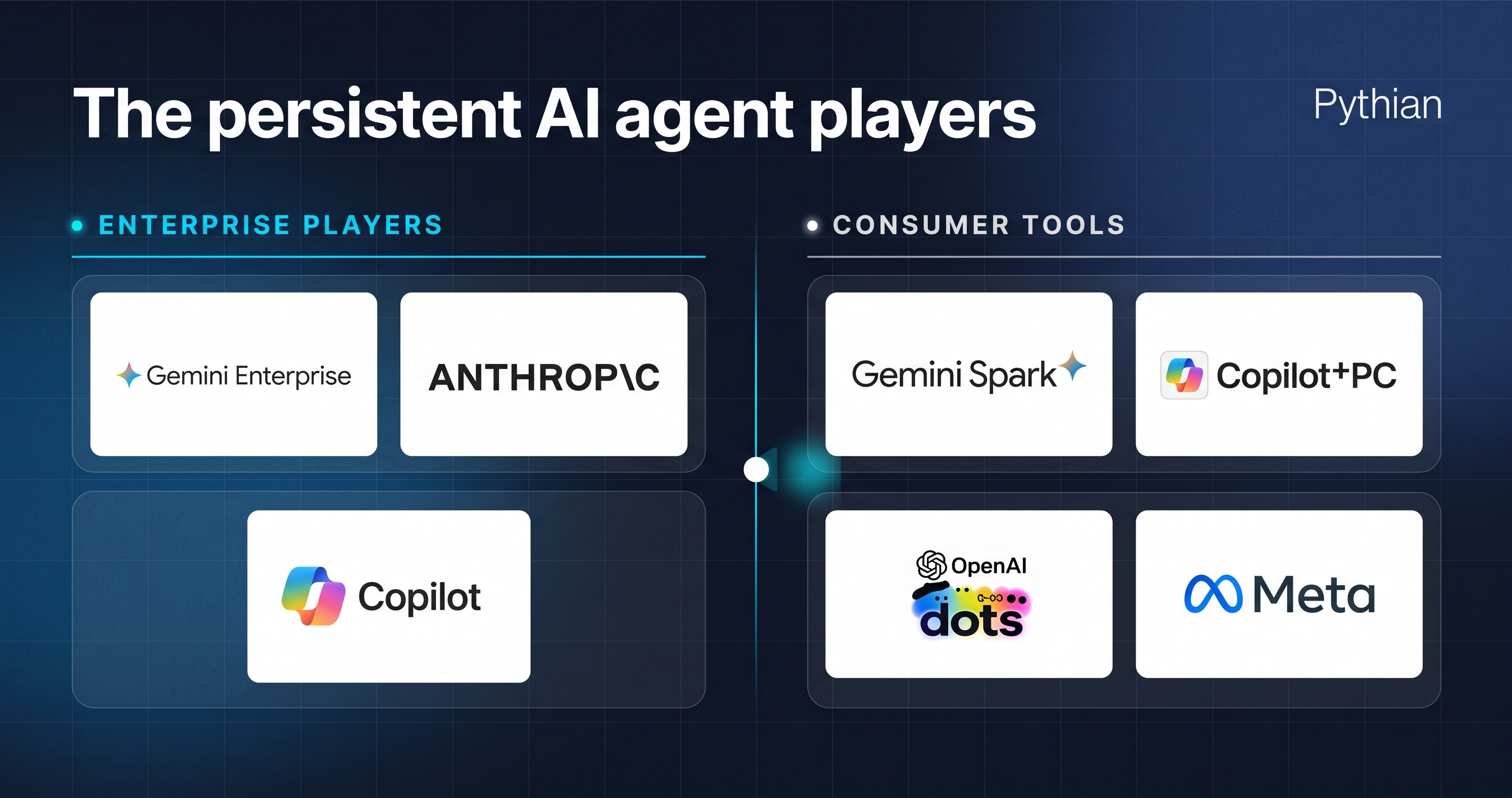
|
Vendor/product |
What it is |
Persistence and execution |
Enterprise posture |
Strategic read |
|---|---|---|---|---|
|
|
Consumer personal agent |
Dedicated Secure VM, browser, connected credentials, background execution, and Sentinel approval layer. |
Primarily consumer-led; enterprise controls and enterprise sales credibility are less established than Microsoft, Google, Anthropic, or AWS. |
Strong demonstration of the “agent owns a computer” model; weakest enterprise trust position. |
|
|
Always-on personal and specialist agents |
Dedicated cloud computer, background work, broad application connections, ChatGPT/Slack/Teams access, and configurable approval rules. |
Enterprise rollout is admin-controlled; specialist Dots are being connected to Microsoft Agent 365. |
Strong brand, developer ecosystem, and agent experience; must prove governance, reliability, and economics at scale. |
|
|
Google’s personal persistent agent |
Google Cloud virtual machines, Workspace integration, and external tools through MCP. |
Consumer-facing today, but strategically important because it demonstrates Google’s Workspace and Cloud distribution advantage. |
Google’s answer to the personal-agent category; the enterprise platform is Gemini Enterprise, not Spark itself. |
|
|
Unified enterprise agent stack |
Cloud-based execution, 4-tier memory architecture (session, semantic, procedural, episodic), dynamic sub-agent spawning, and dedicated @agent coworker identities. |
Admin-controlled via enterprise Skills/Tools registries, MCP connectors, smart-routing cost caps, and Workspace policy management. |
Google’s new core enterprise agent engine; combines Workspace ubiquity with multi-model orchestration across Gemini and Anthropic Claude models. |
|
AI-enabled Windows hardware category |
Local AI features through an NPU; endpoint capabilities rather than autonomous enterprise work. |
Not an agent platform. |
Relevant to device strategy and local inference, but not a direct peer to Muse, Dots, Spark, or Cowork. |
|
|
Microsoft 365 Copilot / Copilot Studio / Agent 365
|
Microsoft’s enterprise agent stack |
Embedded in Microsoft 365; Copilot Studio supports workflows and computer-using agents. |
Very strong because identity, data, security, procurement, and workflow systems already exist. |
Probably the strongest incumbent position inside Microsoft estates. |
|
Anthropic Claude Cowork / Managed Agents
|
Persistent knowledge-worker agents and developer platform |
Scheduled/background work, browser and tool use, persistent task execution, cloud execution, and connector controls. |
Enterprise controls include role-based access, spend limits, analytics, per-tool permissions, and OpenTelemetry. |
Credible challenger for regulated and knowledge-intensive work, particularly where trust and model quality matter more than suite ownership. |







Gemini at work
If you followed Google’s Gemini at Work event on October 8, you saw a massive leap forward for enterprise productivity: the unified Gemini Agent. By giving agents persistent memory, multi-step task planning, sub-agent spawning, and dedicated Workspace identities—complete with their own email addresses and audit logs—Google has laid the groundwork for true digital coworkers.
It is an exciting release that opens up huge possibilities, but turning those possibilities into real enterprise ROI requires looking at what happens beneath the runtime:
-
Model Choice: Google enabling the Gemini agent to run on models like Claude is a huge win for flexibility—it proves model selection is becoming a fluid setting rather than a permanent architectural lock-in. The strategic focus now shifts higher up the stack to your skills registry, agent identities, and long-term memory layers.
-
Operational Reality: The seamless, multi-step execution shown on stage is the destination every business wants. Reaching it relies on foundational data health—like a fully populated Knowledge Catalog and clean source permissions. If your company currently has three different definitions of "gross margin" across sales, finance, and BI, setting up an agent is the perfect catalyst to unify those metrics once and for all.
-
Governance Opportunity: Google introduced essential administrative features like per-project spend caps and non-human identities. The next natural step for enterprise leaders is defining who in the organization stewards these new digital team members, manages their access, and owns their operational budgets.
The Pythian take: Google just gave the enterprise a world-class engine. But an engine needs a chassis, a steering wheel, and a licensed driver to actually go anywhere safely.
How to evaluate this announcement in your business:
-
From Model Selection to Skill Authoring: Don't spend months running LLM bake-offs. Focus your energy on creating a Skills Library—converting your company's implicit process knowledge into structured, machine-readable instructions.
-
From Data Pipelines to Data Definitions: Accuracy in agentic workflows isn't driven by larger context windows; it's driven by standardized semantic definitions (like Google's Knowledge Catalog integration).
-
From Tool Management to Non-Human Governance: Before issuing an agent its own Workspace account, establish who approves its scope, who audits its action log, and who turns off the budget cap when an execution loop runs wild.
Headwinds: Product maturity vs. enterprise acceptance
When evaluating agent platforms like Microsoft Agent 365, Google Gemini Agent, Anthropic Claude Cowork, or Meta Muse, we must separate two metrics:
Product maturity
Is the agent Demo Real (works in a scripted video), Workflow Real (handles basic variance), or Business Real (survives system errors, API updates, and retries while consistently driving ROI)?
Enterprise acceptance
Can IT, security, and procurement actually approve it? Who is liable when an agent makes an error? Where are credentials stored? Can security pull a full audit log in real time?
Today, no vendor on the market offers unrestricted, unsupervised enterprise autonomy. Microsoft leads in enterprise control points because identity (Entra), security, and productivity software are already deeply entrenched. Google Cloud and Gemini Enterprise provide an exceptional platform for custom enterprise orchestration and data integration.
Meanwhile, consumer-first agent models may show mind-blowing demos, but they lack the enterprise trust and compliance foundation required by a modern CIO.
The bottom line: Building your agent operating model
The enterprise market won't be won by the vendor with the flashiest agent demo. It will be won by the organizations that build a disciplined AI Operating Model.
At Pythian, we help enterprise leaders navigate this transition:
- Persistent Agent Readiness: We align executive strategy, audit your data estate, and select high-ROI workflows with defined risk boundaries.
- Persistent Agent Activation: We engineer secure connectors, integrate identity and permissions, build explicit human approval loops, and deploy into production.
- Persistent Agent Operations (AgentOps): We manage continuous evaluation, monitor error rates, enforce token/cost governance, and handle ongoing prompt and policy lifecycle management.
Vendors will continue to sell software. Pythian has our AI operating model that turns persistent agents into safe, accountable, and high-performing enterprise digital workers.
Ready to evaluate where persistent agents fit into your technology roadmap? Let’s talk.
Share this
Share this

AI Chatbots vs AI Assistants vs AI Agents

What is an AI Agent?