


Corporate AI implementation failure has become one of the defining technology challenges of 2025 and 2026. Despite record levels of investment (projected to reach $632 billion globally by 2028) the vast majority of AI projects never deliver measurable business value. In fact, MIT's 2025 State of AI in Business report found that 95 percent of enterprise AI proof-of-concept projects fail to achieve financial return on investment (ROI).
-png.png?width=960&height=540&name=AI%20%5BOn-Demand%5D%20Webinar%20_%20Why%20AI%20projects%20fail%20%20(2)-png.png)
The problem isn't the technology. It's the execution.
At Pythian, we've conducted over 50 AI workshops with enterprises across industries over the past 18 months. We've seen what works, what doesn't, and where organizations consistently get stuck. Keep reading to learn the real reasons why AI implementations fail—including the data gaps, the organizational blind spots, and the hidden costs—and what technology leaders can do to ensure their next AI initiative actually reaches production.
And, if you're looking for a partner who specializes in bridging the gap between AI pilot and production, explore our AI implementation services.
The scale of AI implementation failure: What the data shows
The challenges enterprises face in implementing AI are systemic and well-documented.
MIT's 2025 research revealed that only 5 percent of enterprise AI pilots deliver measurable business value, despite $30 to $40 billion in investment. S&P Global reported that 42 percent of companies abandoned most AI initiatives before reaching production—up from 17 percent the year before. And Gartner's 2025 survey found that only 20 percent of low-maturity organizations keep AI projects operational for three years or more.
And perhaps the most striking figure: only 1 percent of leaders call their companies "mature" on the AI deployment spectrum, and just 22 percent of organizations have a visible, defined AI strategy.
The investment-to-value gap is staggering, and should be a red flag to any CIO, CTO, or CPO looking to implement production AI. In 2025, 85 percent of organizations were actively investing in AI projects, yet only 15 percent were achieving ROI. As Pythian Chief Technology (CTO) Officer Paul Lewis puts it: “Many companies have bought tools, chosen tools, implemented tools, and said 'make it so.' But it's not that easy.”
But this isn't just an enterprise problem. Small and midsize businesses (SMBs) face even steeper odds, with failure rates ranging from 40 to 90 percent, primarily due to lack of software development maturity and insufficient infrastructure for production-grade deployments. In finance alone, the industry has invested over $100 billion since 2020, but 80 percent of AI projects never make it to production.
Why AI implementations fail: The 7 most common root causes
After working with dozens of organizations through our AI workshops, we've identified a consistent set of root causes. These aren't theoretical—they're patterns we see repeatedly across industries and company sizes.
1. AI is ready, but your data isn't
This is the number one failure point, and it's not new. As we've seen in our workshops, the same data problem that plagued analytics in 2010 and business intelligence and machine learning in 2016 is now crippling AI projects in 2025: data is still messy, siloed, and all over the place. The bigger bowl of yarn just has more strings.
-png.png?width=960&height=540&name=AI%20%5BOn-Demand%5D%20Webinar%20_%20Why%20AI%20projects%20fail%20%20(1)-png.png)
70 percent of leaders cite data quality and governance as their number one technical hurdle. And 85 percent of leaders admit they must upgrade their existing IT infrastructure before AI can truly be plug and play. AI is only as good as the proprietary data it can access. Garbage in still means garbage out.11
Data cleaning and labeling alone can represent 20 to 40 percent of total project budgets—a cost most organizations dramatically underestimate.
2. No clear business problem
Too many AI projects start as technology experiments rather than solutions to validated business needs. Teams chase the hype without defining what success looks like. RAND Corporation research confirms that projects launched without well-defined business problems or measurable success criteria are among the most likely to fail.
In our workshops, we regularly see organizations submit dozens of AI use cases that, after proper education, turn out to not be AI problems at all. The first step isn't picking a model, but instead defining a measurable business outcome.
3. Legacy system integration gaps
A model that works in a notebook isn't a model that works in production. Enterprises consistently struggle to integrate AI with existing enterprise resource planning (ERP), customer relationship management (CRM), and workflow systems. Technical debt from legacy architectures creates bottlenecks that trap projects in pilot purgatory.
As we've observed firsthand, AI by its nature tends to be decentralized—you don't want to move the data to the model, you want to move the model to the data. This is fundamentally different from traditional data architecture, and organizations that don't account for this end up making poor architectural decisions that doom projects before they start.
4. Lack of MLOps
Deployment is just the beginning. Without robust machine learning operations (MLOps)—monitoring, retraining, and drift detection—models degrade silently in production. Feature inconsistency between development and production, absence of versioning, and inability to handle scaling are common failure modes.
We recently worked with an organization that rolled their own model trained on 2022 data and was asking 2025 questions. They were getting wrong answers, making wrong strategic decisions, and didn't even know it. That's what happens without proper MLOps.
5. Organizational silos and skills gaps
AI projects span multiple departments, but organizational silos and unclear ownership stall progress. Change resistance and insufficient focus on workforce reskilling make things worse.
Here's a number that surprises most executives: 70 percent of your AI investment should go toward people (change management, training, teaching how to prompt, and ensuring the way people work tomorrow is different from today.) Just 20 percent goes to tools, and 10 percent to the models themselves. Organizations that invert this ratio (spending almost everything on tools and almost nothing on people) consistently fail.
6. Unrealistic timelines and expectations
Executives expect AI ROI in six months. To be truthful, a realistic timeline is 18 to 36 months. That gap between expectation and reality leads to disillusionment and premature project abandonment.
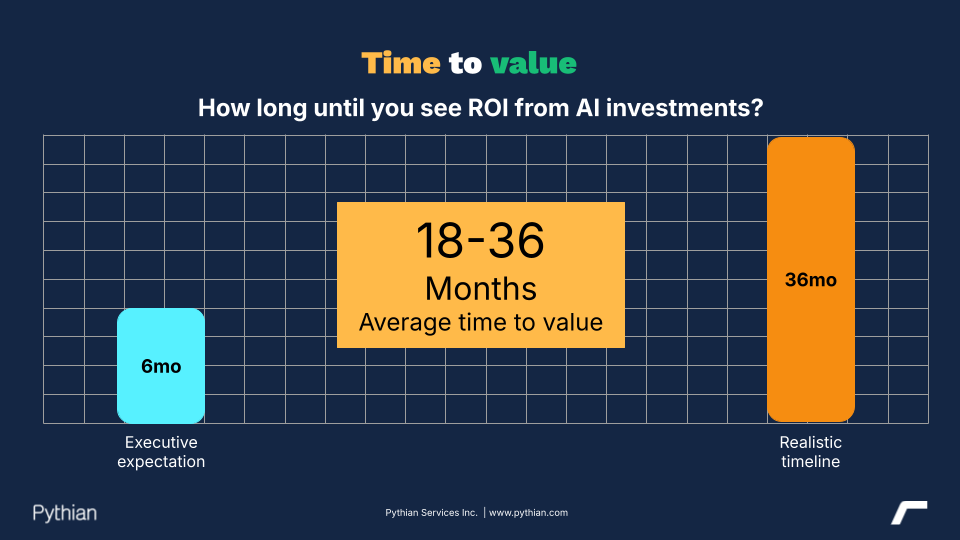
APQC research shows that the disconnect between hype and reality is one of the primary drivers of AI project cancellation. Three-year AI strategies fall apart because in three years there have been six different innovations, hundreds of new models, and an explosion of new use cases. Organizations need to think in smaller, bite-sized increments.
7. Governance as an afterthought
Governance tends to be treated as a follow-through activity, but in AI it needs to be a leading indicator. Gartner specifically calls out "responsible AI as an afterthought" as a primary reason AI projects fail.
Without proper AI policy, employees will bring personal GPTs to work (shadow IT) and start feeding company data into uncontrolled tools—creating data leakage, IP risk, and compliance exposure. Responsible AI is not a compliance checkbox but a revenue protector. Trust is the new currency.
Hidden costs of AI implementation: What SMBs and enterprises miss
The SMB AI implementation challenges around hidden costs are real—and they're not limited to small businesses. Executives at every scale consistently underestimate the true cost of AI projects.
- Data preparation: Continual need for high-quality, labeled data drives up operational costs far beyond initial estimates.
- Integration and infrastructure: Legacy system modifications, middleware development, and cloud scaling can add 30 to 50 percent to initial estimates.
- Ongoing MLOps: Continuous monitoring, retraining, and model validation require sustained investment in specialized talent and tooling.
- Opportunity cost: Internal teams diverted from core business. Rework costs can double or triple initial vendor estimates.
- Platform lock-in: Architectural conclusions driven by a single provider—it's easy to go all-in until you realize you can't. Over-reliance on proprietary platforms increases long-term switching costs.
The financial toll of getting this wrong is enormous. Zillow's AI-powered home-buying algorithm failure led to over $500 million in losses and a 25 percent workforce layoff. Across all industries, the estimated economic loss from failed AI initiatives exceeded $644 billion in 2025 alone.
Key challenges in implementing generative AI
If you're hoping generative AI is different, the data says otherwise. MIT's 2025 study and S&P Global both report that 95 percent of GenAI pilots fail to deliver measurable impact, with 42 percent scrapped before production.
Generative AI introduces additional failure modes on top of the traditional challenges:
- Hallucination and accuracy: Models generate plausible but incorrect outputs that can lead to wrong strategic decisions in production.
- Prompt engineering at scale: What works in a demo breaks in complex enterprise workflows. As Cognizant's research notes, scaling prompt-based systems requires fundamentally different engineering practices.
- Data privacy and IP leakage: Without proper controls, proprietary data can leak through large language model (LLM) interactions—especially when employees use personal AI accounts for work tasks.
- Cost unpredictability: Token-based pricing can explode at enterprise scale, making financial planning difficult.
- The integration gap: Internal GenAI builds fail twice as often as vendor solutions, and most GenAI tools fail to integrate into real business workflows.
The fundamentals haven't changed. Data quality, integration, MLOps, and governance still determine whether your generative AI initiative reaches production or joins the 95 percent.
How to ensure your AI implementation succeeds
The organizations that make up the successful 5 percent share consistent patterns. Based on our experience across 50+ enterprise AI workshops, here's what separates success from failure:
1. Start with a readiness audit, not a model.
Assess your data architecture, quality, and accessibility before writing a single line of code. Identify integration points with existing systems. Define success metrics tied to specific business key performance indicators (KPIs)—not vague "AI transformation" goals.
2. Invest in people first.
Remember the 70/20/10 rule: 70% of your AI investment should go toward change management, training, and adoption. 20% toward tools and platforms. 10% toward models. Organizations that flip this ratio are the ones filling out failure statistics.
3. Build a composable, cloud-agnostic platform.
Don't get locked into a single provider's architecture. Create a flexible, scalable infrastructure that allows you to swap models and services as the technology evolves. Whether your data lives on Google Cloud, AWS, or Azure, your enterprise AI implementation partner should meet you where your data lives.
4. Implement MLOps from day one.
Treat your AI system like any other mission-critical application. Monitor model health, detect drift, and build automated retraining pipelines. If you wouldn't deploy a CRM without monitoring, why would you deploy an AI model without it?
5. Make governance a leading indicator.
Build compliance, security, and ethical guardrails into your implementation framework from the start—not as a follow-through activity. This includes AI policy, acceptable use guidelines, and data privacy by design.
6. Think small to scale big.
Avoid "boil the ocean" projects. Successful teams focus on automating one high-value task at a time, proving ROI, then expanding. Budget up to 40 percent of resources for post-launch optimization and continuous improvement.
7. Partner strategically.
The data is clear: organizations that partner with specialized implementation vendors achieve a 67 percent deployment success rate, compared to just 33 percent for purely internal builds. The talent gap is real—building a prototype requires fundamentally different skills than deploying and maintaining a production system.
Don't let your AI investment become another statistic
Corporate AI implementation failure isn't a technology problem. It's an execution problem rooted in strategy, data, organizational alignment, and operational rigor.
The 95 percent failure rate is entirely preventable. The organizations that succeed start with clear business problems, invest in their data foundation and their people, build governance into the fabric of their AI programs, and partner with experts who specialize in the hardest part of the journey: getting from pilot to production.
At Pythian, we've spent over 25 years in data engineering and are currently helping enterprises navigate exactly this challenge through our AI workshops and implementation services. We know where the landmines are because we've helped dozens of organizations avoid them.
Ready to turn your AI pilot into a production-ready deployment? Whether you need a readiness audit, a data strategy, or end-to-end implementation support, our team specializes in the technical heavy lifting that gets AI from prototype to production.
Share this
Share this

AI Implementation Strategy: The 4-Phase Roadmap to Production-Ready AI

AI Implementation Consultants: The Definitive Guide to Choosing the Right Partner


.svg)
.svg)