



Google Cloud’s Gemini Enterprise Agent platform marks an operational shift in enterprise technology: moving from passive, prompt-based chatbots to autonomous, multi-step execution. Enterprise leaders no longer need standalone language models; they need an enterprise-grade platform to build, orchestrate, and deploy business process AI automation that delivers measurable ROI.
Moving visual agent prototypes into production requires more than developer tooling. Delivering bottom-line returns requires specialized AI automation consulting—an end-to-end discipline where Pythian builds, integrates, and manages AI solutions to automate complex business processes, ensuring your investments maximize ROI.
What the Gemini Enterprise Agent platform actually is
Rather than an isolated developer feature, the Google Agent Platform is a runtime environment engineered to build and run autonomous workflows. Google Cloud has consolidated its agentic tooling into a unified stack for business process automation:
- Unified Build Environments (Agent Studio & ADK): A shared workspace that serves both citizen developers and software engineers. Business teams can map out logic using visual, low-code tools in Agent Studio, while engineering teams can build complex, custom reasoning engines with code using the Agent Development Kit (ADK).
- Persistent Execution (Agent Runtime & Memory Bank): Traditional AI chats forget everything once a prompt ends. Agent Runtime and Memory Bank give automations long-term memory, enabling workflows to run across multiple days, remember past cross-system interactions, and resolve complex multi-departmental processes without losing context.
- Governed Enterprise Access (Agent Identity, Registry & Gateway): The enterprise security layer that protects your core systems. It assigns every automated agent a verifiable role-based identity, maintains an approved catalog of agent skills, and enforces strict security checks before an agent can touch production databases, ERPs, or external APIs.
- Simulation & Governance (Agent Evaluation & Observability): A dedicated testing and monitoring suite that stress-tests automated workflows against real-world edge cases. It tracks task completion rates, identifies broken logic loops, and audits inconsistent responses before an agent ever interacts with live data.
- Multi-Model Orchestration (Model Garden): A smart routing layer that matches the right AI model to the right task. The platform can send complex, multi-step problem solving to high-powered reasoning models (like Gemini Pro) while routing fast, routine lookups to lightweight models (like Gemini Flash) to keep speed high and cloud costs down.
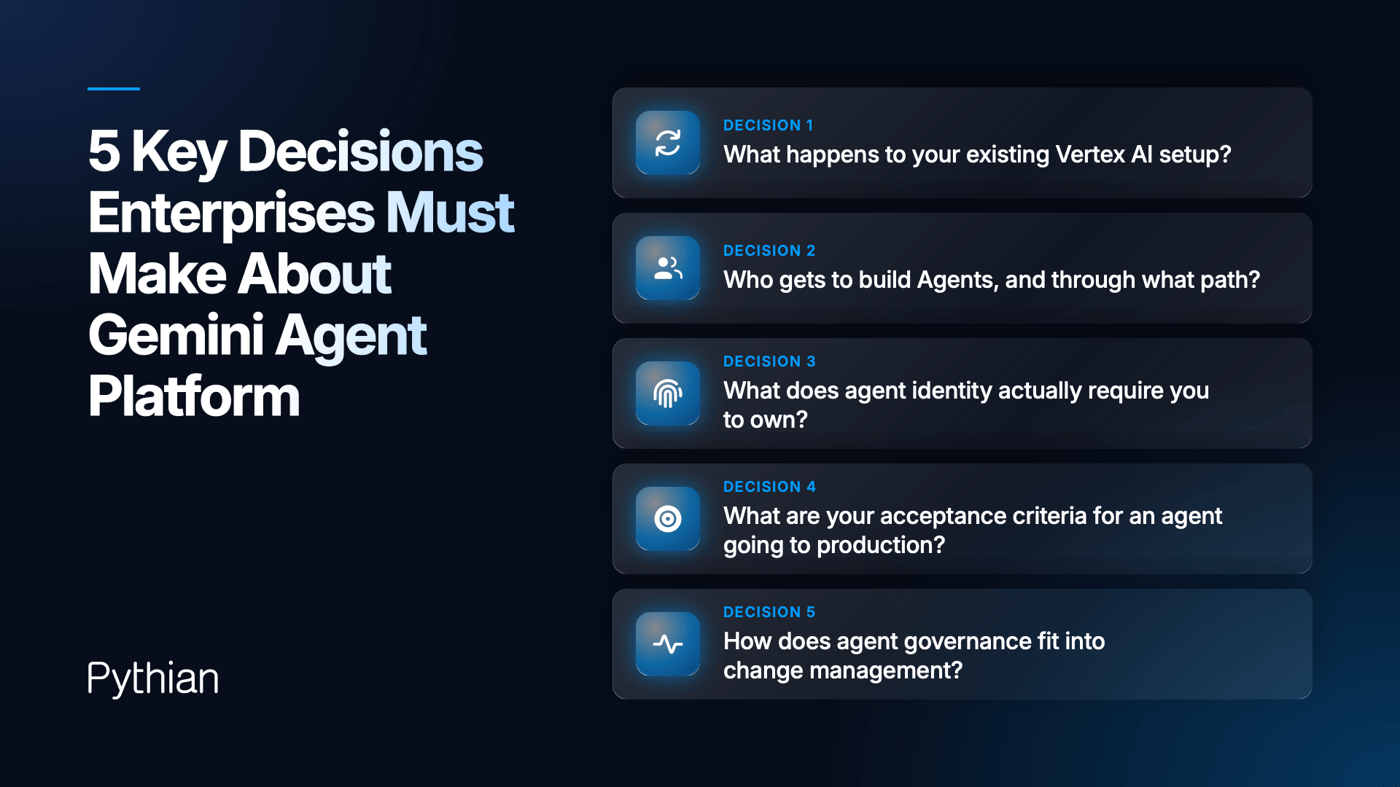
5 decisions enterprises must make (and how Pythian bridges them)
Operationalizing Google’s Agent Platform requires navigating five architectural and operational paths. Here is how Pythian’s AI delivery framework bridges each decision to production reality:
Decision 1: What happens to your existing Vertex AI setup?
Treating current Vertex AI deployments and the new Agent Platform as disconnected silos accumulates technical debt. Workloads closest to multi-step agentic patterns should migrate first, while pure batch model inference can remain on its current pipeline.
- The Pythian Blueprint (AI Strategy & Roadmap): Pythian audits your existing data estates and model footprint. We prioritize migrations based on immediate business process ROI rather than technical parity alone, ensuring you modernize high-impact workflows with zero unplanned downtime.
Decision 2: Who gets to build Agents, and through what path?
Agent Studio (visual low-code) and the ADK (code-first engineering) attract different builders with different operational risk profiles. Allowing non-technical teams to assemble agents that interface with core databases without governance invites security vulnerabilities and broken pipelines.
- The Pythian Blueprint (AI Workshop & Governance): Through our AI Workshop methodology, we help leadership establish operating models, access privileges, and review paths. We configure secure sandbox environments where business users prototype automations while ensuring production-bound agents pass enterprise architectural standards.
Decision 3: What does agent identity actually require you to own?
Agent Identity, Agent Registry, and Agent Gateway provide governance infrastructure, but they do not configure your internal policies. Regulated organizations must define who owns an agent's behavior, which datasets it can query, and what security fences block unauthorized transactions.
- The Pythian Blueprint (Data Readiness Assessment): Autonomous agents can’t execute reliable logic over un-governed data. Pythian conducts a Data Readiness Assessment to validate data pipelines, access boundaries, and schema hygiene. We configure role-based access control (RBAC), preventing sensitive data leakage across core ERP, CRM, and database estates.
Decision 4: What are your acceptance criteria for an agent going to production?
Agent Simulation and Agent Evaluation require definitive baseline criteria. Traditional QA gates were designed for deterministic software with predictable logic—not probabilistic systems that dynamically reason through multi-step tasks.
- The Pythian Blueprint (AI Development & Deployment): As part of our enterprise AI automation services, Pythian establishes quantitative evaluation benchmarks. We define precise task-completion thresholds, edge-case failure modes, and automated fallback gates that prevent unvetted agents from impacting live customer transactions or financial ledgers.
Decision 5: How does agent governance fit into change management?
An agent’s runtime behavior can drift without code deployments—triggered by unpinned model endpoint aliases, shifting retrieval context in vector search, or dynamic memory consolidation in Memory Bank. Traditional Change Advisory Boards (CABs) are not configured for autonomous, probabilistic drift.
- The Pythian Blueprint (AIOps Consulting & Managed Services): Pythian deploys specialized AIOps consulting and managed operations. We implement 24/7 runtime observability, behavioral guardrails, and automated anomaly detection to monitor agent decisions, prevent prompt regressions, and contain cloud compute and token costs.
Quantifiable enterprise impact: Gemini Agent platform capabilities
Enterprise investments in agentic infrastructure must deliver verifiable business returns. Here is how targeted workflow automation transforms everyday business processes into measurable operational and financial returns::
|
Gemini Agent Platform Capability |
Automated Business Process |
Tangible Business Return |
|
Agent Runtime + Memory Bank |
Multi-day procurement reconciliation, supplier invoice auditing, and claim adjudication across legacy systems. |
Reduced costs: Eliminates manual human handoffs, status checks, and repetitive data cross-referencing. |
|
Agent Studio Low-Code Workflows |
Departmental knowledge lookups, customer service triage, and automated employee onboarding sequences. |
Increased operational efficiency: Automates routine administrative overhead, freeing internal teams for higher-value tasks. |
|
Agent Gateway + Tool Calling |
Real-time bi-directional transactions across core enterprise platforms (SAP, Oracle, Salesforce). |
Faster business processes: Accelerates end-to-end execution timelines from business days to sub-second transactions. |
|
Agent Evaluation & Simulation |
Continuous regulatory compliance validation, policy enforcement checks, and financial calculation auditing. |
Reduced business risk & improved business continuity: Catches non-deterministic errors and enforces guardrails prior to deployment. |
|
Model Garden Multi-Model Routing |
Dynamic task allocation (routing complex reasoning to Gemini 2.5 Pro and high-volume tasks to Flash models). |
Improved scalability and performance: Scales concurrent process capacity without generating exponential cloud compute costs. |
Proven case studies: Pragmatic automation in production
Pythian engineers and manages production AI systems that drive bottom-line business outcomes:
- Wayfair (Retail & Catalog Optimization): Partnered with Wayfair to engineer custom AI models for supply chain accuracy and product data validation, eliminating catalog inconsistencies across vast supplier networks.
- Day & Ross (Logistics & Document Processing): Built an automated document processing AI solution for freight giant Day & Ross, converting manual shipping paperwork into real-time operational streams and decreasing driver dwell time by 92%.
Operationalize Gemini agents with Pythian
Moving from experimentation to enterprise-wide execution requires clean data architecture, platform engineering, and structured change management. As a Google Cloud Premier Partner with 30 years of data heritage, Pythian turns Google's agentic platform into an operational growth engine.
Through pragmatic AI automation consulting and enterprise AI automation services, your organization gains secure, governable autonomous workflows engineered to eliminate operational bottlenecks and deliver measurable bottom-line value.
Ready to turn your enterprise data into autonomous execution?
Share this
Share this

Guide to Agentic AI Design Patterns: From Theory to Enterprise AI Automation
Persistent AI Agents: Why Enterprise Automation Demands an Operating Model and Strategy