



Most enterprise AI initiatives stall at the chatbot stage: A user submits a prompt, and a model returns static text.
Although effective for ad-hoc queries, this linear structure cannot handle multi-step operational work—a limitation agentic AI design patterns are built to solve.
What Are Agentic AI Design Patterns?
Agentic AI design patterns are reusable architectural blueprints that enable systems to plan, reason, execute tools, and self-correct across multi-step enterprise workflows.
Unlike traditional single-prompt models, these patterns guide systems through continuous execution loops—breaking goals into discrete tasks, orchestrating external tools, and adapting based on feedback.
While foundation models provide baseline reasoning, operational automation requires tying models, memory, and enterprise APIs into governed workflows.
Moving from conceptual design patterns to production-ready enterprise execution is where AI automation consulting becomes essential. At Pythian, we build, integrate, and manage AI solutions to automate complex business processes—ensuring that agentic architectures deliver reliable, quantifiable ROI rather than isolated experiments.
From linear prompts to AI automation with agentic design patterns
Consumer “chat” AI interactions typically follow a simple, linear structure: Prompt → Response. This is often referred to as "Zero-shot" or "One-shot" prompting. This linear approach for simple queries, but it lacks the depth required for complex enterprise work.
In contrast, agentic AI design patterns guide LLMs to operate through a continuous execution cycle. This iterative approach allows enterprise systems to establish automation by:
- Deconstructing complexity: Breaking down broad objectives into manageable sub-tasks.
- Gathering context: Pulling information from APIs, databases, and diverse data sources.
- Self-correcting: Evaluating the accuracy of outputs and adjusting behavior if results are incomplete or illogical.
- Adapting: Modifying the "Plan" based on new "Observations" made during the "Action" phase.
What are the core agentic AI design patterns?
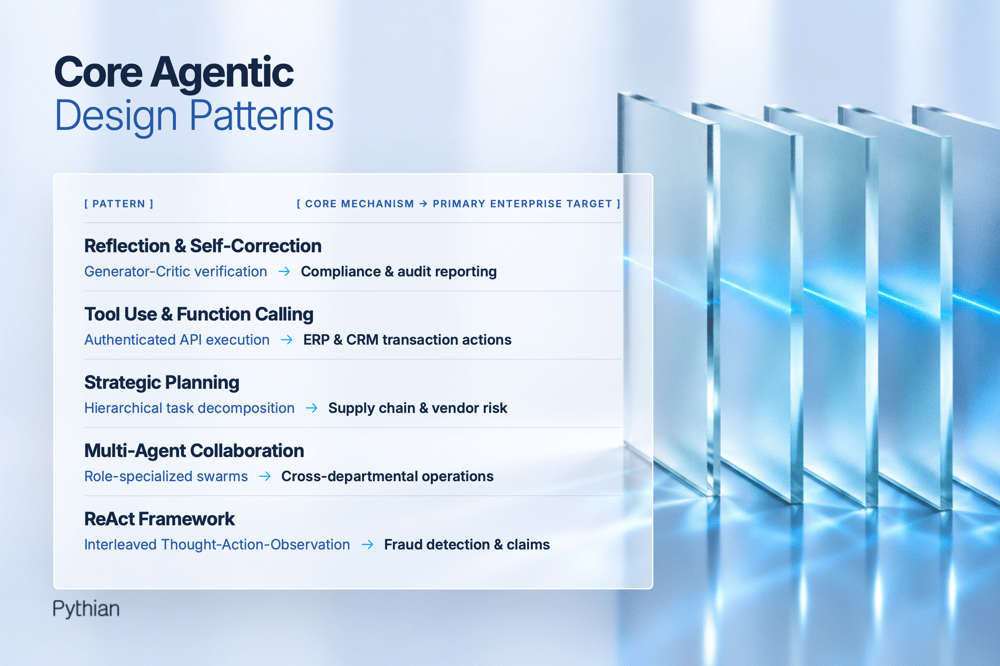
A production-grade enterprise AI automation roadmap rarely relies on a single pattern. Sustainable implementations combine several of these five core patterns to deliver speed, accuracy, and operational governance:
Pattern 1: Reflection & Self-Correction
Standard language models operate as one-shot engines, generating text sequentially without checking for technical constraints or business policies. In enterprises, this leads to compounding errors, non-compliant phrasing, and hallucinations.
The Reflection pattern solves this by introducing a dual-agent feedback loop:
- The Generator Agent produces the initial artifact (code, queries, or summaries).
- The Critic Agent evaluates that output against strict rules and validation schemas.
If the critic spots an error, it sends feedback to the generator, which refines the output until it meets your quality standards.
 Enterprise process automated: Contract review, automated compliance reporting, syntax validation in software engineering.
Pattern 2: Tool Use & Function Calling
Language models process text; they cannot directly change system states. Tool Use and Function Calling bridge this gap, giving models access to structured APIs, database connectors, and command-line utilities.
When an agent needs external data or needs to take action, it formats a structured request. The host environment then executes the call and feeds the result back to the model to drive the next step.
 Enterprise process automated: Autonomous three-way invoice matching and ERP clearance, automated IT infrastructure provisioning via cloud APIs.
Translating agentic tool use into business process automation
In theory, giving an agent tool-calling capabilities is simple. In an enterprise environment, however, agents require secure, low-latency access to mission-critical platforms like Oracle, Google Cloud, SAP, and Snowflake. This can be achieved through:
- Data readiness assessment: An agent cannot execute reliable logic over unhygienic data. Auditing data pipelines, schemas, and vector indexes ensures agents operate with reliable context.
- AI tool Integration: Real-world automation requires embedding autonomous intelligence directly into existing CRMs, ERPs, and database estates with strict role-based access control (RBAC). Rather than granting agents administrative database credentials, Pythian engineers build microservice wrappers and least-privilege API contracts that mirror human enterprise security policies.
Pattern 3: Strategic Planning
Strategic Planning enables an agent to act as an operational architect. When given a high-level goal, the agent breaks it down into a structured map of subtasks, planning execution order, dependencies, and parallel steps.
Crucially, this planning is dynamic. As tasks execute, the agent processes real-time results. If a step fails, like an API returning "out of stock", the agent instantly rewrites the remaining plan to find an alternative.
 Enterprise process automated: Complex supply chain logistics analysis, vendor risk modeling, and multi-tier market research.
Pattern 4: Multi-Agent Collaboration
As enterprise workflows expand, assigning every responsibility to a single agent leads to context window saturation, conflicting instructions, and brittle performance.
Multi-Agent Collaboration addresses this by mirroring human teams. Instead of one generalist agent, architectures deploy a fleet of specialized sub-agents, each equipped with dedicated system prompts, toolsets, and bounded responsibilities.
To function effectively, this pattern relies on distinct core roles. For instance, it can have agents with different roles such as a Researcher (gathers data and context), a Writer (drafts content or code), and a Reviewer (checks for compliance and accuracy).
A central Orchestrator Agent acts as the project manager: it triages incoming work, delegates steps to domain specialists, reviews deliverables, and synthesizes the outcome.
 Enterprise process automated: Cross-departmental major incident response, complex enterprise IT service desk resolution, and collaborative vendor onboarding spanning legal, procurement, and finance workflows.
Why do production agent patterns require dedicated AIOps?
Multi-agent systems introduce operational complexity that standard software DevOps is not equipped to manage:
- Loop containment and cost control: Autonomous agents can burn through thousands of API calls if a tool execution fails silently.
- Model drift and accuracy: Changes in underlying LLM versions or data distributions can degrade reasoning logic over time.
Effective AI automation consulting pairs initial development with ongoing AIOps: implementing guardrails, continuous model evaluation, and cost governance to maintain long-term system integrity.
Pattern 5: the ReAct framework (reasoning + action)
The ReAct pattern (reasoning + action) is one of the foundational patterns of autonomous system architecture. While standard models separate reasoning from action, ReAct tightly interleaves them into a continuous operational trace:
Thought -> Action -> Observation -> Updated Thought
By enforcing an explicit reasoning step before every external action, the agent verbalizes its internal hypothesis. After the action executes, the agent analyzes the concrete output returned by the system (Observation) before deciding whether to proceed, try an alternate approach, or conclude the task.
 Enterprise process automated: Real-time customer claim adjudication, live financial anomaly detection.
Pythian’s reusable agentic patterns for enterprise AI automation
While foundational patterns establish core agent behaviors, production enterprise automation requires specialized architectures tailored to specific operational friction points.
Pythian has developed battle-tested patterns that serve as reusable blueprints for high-value workflow automation. Rather than inventing solutions from scratch and absorbing unnecessary risk, we activate existing, high-impact architectures that ensure predictable, production-grade AI automation.
Pattern A: Agentic Document Processing
This pattern eliminates manual document intake bottlenecks by transforming unstructured, multi-format paperwork into structured, validated system-of-record entries automatically.
|
Phase |
Operational Workflow |
|
|
1. |
|
Ingest paper, handwritten forms, scans, or ad-hoc digital files into standardized image and PDF formats |
|
2. |
|
Apply computer vision, OCR, and multimodal LLMs to extract key target fields. |
|
3. |
|
Align and normalize extracted fields to your corporate data schema. |
|
4. |
|
Execute business validation rules, master data cross-checks, and external lookups to flag anomalies. |
|
5. |
|
Insert clean, auditable, structured data directly into core systems of record (TMS, ERP, CRM). |
|
6. |
|
Autonomously initiate downstream workflows, approval notifications, shipment releases, or billing cycles. |


Industry use cases
- Logistics & freight transportation: Automating Bills of Lading (BOL), customs documentation, and freight invoice reconciliation. Pythian deployed this pattern for Day & Ross to automate document processing, enhancing shipment tracking visibility and accelerating operational throughput across logistics hubs.
- Financial services: Automating Know Your Customer (KYC), Anti-Money Laundering (AML) document collection, and commercial loan application processing.
- Healthcare: Digitizing legacy patient medical charts and extracting clinical data for insurance claims processing.
Pattern B: Multimodal Data Reconciliation
This pattern establishes an authoritative single source of truth across the enterprise by cross-reconciling conflicting data buried across disparate formats, including PDFs, tabular spreadsheets, and visual assets.
|
Phase |
Operational Workflow |
|
|
1. |
|
Consume heterogeneous assets across business units, including PDFs, images, spreadsheets, and vendor data feeds. |
|
2. |
|
Deploy OCR, vision models, and NLP to transform raw, unstructured inputs into structured fields. |
|
3. |
|
Cross-reconcile units of measure, dimensions, and product attributes across textual descriptions, tables, and images. |
|
4. |
|
Apply deterministic business rules and historical context to resolve discrepancies and compute a single source of truth. |
|
5. |
|
Update product catalogs and asset registries within core enterprise systems with clean, verified master data. |
|
6. |
|
Continuously scan for data drift and discrepancies as new supplier feeds and documentation arrive. |


Industry use cases
- Retail & e-commerce: Reconciling conflicting product specifications, dimensions, and images received from diverse third-party vendors to maintain clean, unified digital catalogs.
- Finance & corporate accounting: Automating three-way reconciliation across invoices, purchase orders, and receipts to accelerate month-end financial closing.
- Insurance & healthcare claims: Reconciling claim forms with attached medical records and photographic injury/property damage evidence to accelerate claim adjudication.
Pattern C: Autonomous Data Governance
This pattern maintains continuous data integrity and compliance by proactively detecting schema drift, phantom assets, and duplicate entries across enterprise data estates.
|
Phase |
Operational Workflow |
|
|
1. |
|
Scan ERPs, data warehouses, catalogs, and master reference databases for inconsistencies and drift. |
|
2. |
|
Deploy fuzzy matching algorithms and heuristic rules to identify duplicate customer records and non-existent assets. |
|
3. |
|
Generate deduplication candidates and canonical attribute sets for human approval. |
|
4. |
|
Validate, normalize, and enforce data quality and masking standards at the entry point of ingestion. |
|
5. |
|
Execute approved catalog updates while logging complete end-to-end lineage and compliance audit trails. |
|
6. |
|
Deliver governance signals to ensure downstream operational AI agents execute over accurate data. |


Industry use cases
- Financial services & banking: Automating regulatory reporting lineages, auditing transactional data trails, and masking sensitive PII across global trading platforms.
- Retail & omnichannel CPG: Unifying fragmented customer and SKU registries across in-store POS systems and online storefronts.
- Healthcare & life sciences: Consolidating patient identities across disparate Electronic Health Record (EHR) systems while enforcing automated HIPAA-compliant data masking.
Pattern D: Agentic Knowledge Search & Synthesis
This pattern transforms siloed corporate documentation into an interactive intelligence layer that provides concise, natural-language answers backed by clickable source citations.
|
Phase |
Operational Workflow |
|
| 1. |  Index |
Ingest enterprise documentation, technical manuals, internal sites, and policy wikis while preserving access permissions. |
| 2. |  Enable |
Leverage semantic retrieval and Vertex AI Search/RAG to understand user intent beyond literal keyword queries. |
| 3. |  Answer |
Return concise natural-language answers featuring direct citations and links to authoritative source files. |
| 4. |  Support |
Maintain contextual conversational state across multi-turn inquiries and iterative technical refinements. |
| 5. |  Bridge |
Connect and synthesize siloed knowledge repositories across HR, IT, Finance, and Engineering into single answers. |
| 6. |  Improve |
Continuously evaluate user feedback and query logs to optimize ranking, prompt routing, and relevance filters. |
Industry use cases
- Enterprise software & support: QAD partnered with Pythian to implement enterprise AI search, enabling global employees to query distributed technical repositories and knowledge bases instantly, improving search accuracy and operational velocity.
- Customer care centers: Equipping frontline tier-1 support agents with instant access to complex product manuals, schematics, and prior ticket histories.
- Legal & compliance: Enabling paralegals and compliance officers to semantically query thousands of documents.
- IT & HR self-service: Providing employees with unified conversational portals that instantly resolve technical troubleshooting questions and Board-level HR policy inquiries.
Pattern E: Analyst Co‑Pilot for Research Content
This pattern empowers research and strategy teams to ingest dense, multi-page technical reports and generate objective, data-dense executive briefings without compromising numerical integrity.
|
Phase |
Operational Workflow |
|
|
1. |
|
Consolidate proprietary analyst reports, financial filings, earnings call transcripts, and industry news feeds. |
|
2. |
|
Automatically extract structured metrics, sentiment scores, statistical tables, and strategic themes from text. |
|
3. |
|
Retrieve relevant tabular slices and cross-correlate empirical findings across multiple comparative source documents. |
|
4. |
|
Generate executive summaries, memos, and comparative technology matrices tailored to strict editorial templates. |
|
5. |
|
Ground outputs with direct citations to guarantee total factual fidelity and analyst confidence. |
|
6. |
|
Continuously track incoming data feeds to update living briefings, refresh models, and dispatch automated alerts. |


Industry use cases
- Market research & analyst services: GigaOm collaborated with Pythian to build a custom AI analyst agent using Gemini. The solution replicates research methodologies to synthesize 60-page analyst reports, tables, and graphics into instant, impartial answers for enterprise decision-makers.
- Equity research & corporate finance: Automating first-pass reviews of SEC 10-K filings, quarterly earnings transcripts, and guidance disclosures to surface operational anomalies.
- Corporate strategy: Monitoring competitor product launches and market movements to synthesize continuous competitive intelligence briefings.
- Risk management: Correlating complex insurance claims data with climate and macroeconomic risk reports to assist commercial underwriters.
Pattern F: AI Inventory & Resource Rebalancing
This pattern prevents inventory stockouts and carrying inefficiencies by analyzing multi-stream demand signals and executing autonomous resource rebalancing actions.
|
Phase |
Operational Workflow |
|
|
1. |
|
Audit real-time availability across different warehouse locations. |
|
2. |
|
Track consumption telemetry across warehouses and retail channels to detect impending shortages. |
|
3. |
|
Identify systemic inefficiencies or imbalances. |
|
4. |
|
Forecast demand fluctuations and stockout risks by correlating sales velocity with external signals. |
|
5. |
|
Autonomously push stock transfers, purchase orders, or markdown schedules into ERP and warehouse management systems. |
|
6. |
|
Report on cost savings and ROI compliance. |


Industry use cases
- Grocery & retail: Employing rebalancing agents to sense localized consumer demand, adjusting store replenishments and markdowns to minimize shrink while avoiding stockouts.
- Supply chain & logistics: Rerouting in-transit freight and reallocating regional safety stock based on real-time port congestion data and severe weather warnings.
- Cloud infrastructure: Deploying autonomous agents that dynamically adjust and rebalance cloud instances across regions to lower compute expenditures.
Pattern G: Dynamic Pricing & Revenue Optimization
This pattern optimizes profitability on high-volume commercial transactions by evaluating real-time price elasticity and market signals within deterministic margin guardrails.
|
Phase |
Operational Workflow |
|
|
1. |
|
Ingest competitor prices and demand curves. |
|
2. |
|
Model how margin responds to price changes. |
|
3. |
|
Recommend small, frequent adjustments. |
|
4. |
|
Automatically approve or deny low-risk returns without human intervention. |
|
5. |
|
Adjust stock and trigger refunds or credits. |
|
6. |
|
Route high-risk cases to humans with summaries. |


Industry use cases
- Retail & e-commerce: Executing algorithmic price adjustments based on live competitor stock levels, supplier price hikes, and cart abandonments.
- Hospitality: Adjusting room rates dynamically based on historical booking curves, seasonal demand, and local event pacing.
- Transportation: Dynamically pricing seat inventories to maximize asset utilization.
Pattern H: Agentic Returns, Claims & Reverse Logistics
This pattern minimizes reverse logistics operating costs and fraud exposure by automating merchandise inspection, policy validation, and claim settlements.
|
Phase |
Operational Workflow |
|
|
1. |
|
Scan items and claim documents directly at the edge. |
|
2. |
|
Use vision algorithms and multimodal LLMs to analyze physical item condition. |
|
3. |
|
Verify purchase records, warranty registrations, and customer history to detect fraudulent behavior or policy abuse. |
|
4. |
|
Automatically approve or deny low-risk returns without human intervention. |
|
5. |
|
Adjust stock and trigger refunds or credits. |
|
6. |
|
Route high-risk cases to humans with summaries. |


Industry use cases
- E-commerce returns: Automating consumer return requests, providing instant automated condition grading, and dispatching return shipping labels.
- Warranty claims: Reviewing photographic damage evidence for consumer electronics and appliances to approve warranty repairs or replacements.
- Insurance: Conducting instant preliminary intake and triage for low-complexity auto or property damage claims.
Pattern I: Agentic Workforce & Schedule Orchestration
This pattern balances operational labor costs against customer service levels by dynamically generating optimized, compliant employee shift rosters that adapt to unexpected changes.
|
Phase |
Operational Workflow |
|
|
1. |
|
Combine traffic, ticket volumes, and weather data. |
|
2. |
|
Generate staffing forecasts broken down by department, role, and hours. |
|
3. |
|
Build compliant, cost-optimized shift rosters that match projected workload demands. |
|
4. |
|
Honor labor rules and employee preferences. |
|
5. |
|
Automatically rebalance shifts in real time when unexpected call-outs or foot traffic surges occur. |
|
6. |
|
Track costs and attrition metrics to continuously improve scheduling rules. |


Industry use cases
- Retail store operations: Scheduling retail floor associates based on predictive foot-traffic modeling and peak promotional periods.
- Call centers: Dynamically routing customer support inquiries and adjusting agent shift schedules based on queue volumes and language proficiencies.
- Field technical services: Scheduling and dispatching field technicians based on geographic routes, travel times, and emergency service requests.
Pattern J: AI-Assisted Code Modernization & Migration
This pattern accelerates enterprise cloud migrations by automating legacy schema conversions, procedural code refactoring, and behavioral validation testing.
|
Phase |
Operational Workflow |
|
|
1. |
|
Catalog databases and services, including stored procedures, schemas, and API dependencies. |
|
2. |
|
Categorize objects by technical complexity and target architecture (Cloud SQL, microservices, etc.). |
|
3. |
|
Auto‑propose schema changes, SQL rewrites, and refactored code blocks. |
|
4. |
|
Apply vetted patterns at scale using GenAI toolkits to remove repetitive work. |
|
5. |
|
Run generated tests and data diffs between legacy and modern platforms. |
|
6. |
|
Deploy modernized workloads into cloud‑native infrastructure that can feed downstream AI. |


Industry use cases
- Enterprise e-commerce platforms: Wayfair accelerated its database modernization from Microsoft SQL Server to Google Cloud SQL by utilizing AI-assisted code conversion to refactor queries and stored procedures.
- Mainframe & legacy migrations: Converting legacy COBOL programs and complex Oracle PL/SQL business logic into modern, cloud-native Java and Python services.
- DevSecOps remediation: Automatically scanning enterprise application repositories to refactor vulnerable or deprecated libraries at scale.
Pattern K: Agentic IT Operations (AIOps)
This pattern minimizes Mean Time to Resolution (MTTR) and prevents service outages by filtering telemetry noise, diagnosing root causes, and triggering pre-approved remediation workflows.
|
Phase |
Operational Workflow |
|
|
1. |
|
Centralize logs, metrics, traces, tickets, and deployment events. |
|
2. |
|
Use ML and semantic search to group related alerts into single incidents. |
|
3. |
|
Apply LLMs over KBs and past incidents to propose likely root causes and steps. |
|
4. |
|
Execute pre‑approved runbooks (scale, restart, rollback) for common issues. |
|
5. |
|
Generate incident timelines and post‑incident reviews for SRE/ITIL workflows. |
|
6. |
|
Tune guardrails, risk thresholds, and escalation paths based on real operations. |


Industry use cases
- Database operations: Predictive scaling and query performance tuning.
- Cloud operations: Self-healing common, well-understood infrastructure failure modes without manual intervention.
- Security operations: Conducting first-pass correlation and triage of high-volume security alerts of suspicious access and traffic.
- Service management: Filtering alert noise and automating first-pass incident triage to reduce mean time to resolution.
Pattern L: Enterprise Search & Knowledge Management RAG
This pattern connects distributed repositories into a persona-tailored conversational interface while enforcing enterprise permission boundaries.
|
Phase |
Operational Workflow |
|
|
1. |
|
Attach sites, docs, portals, and databases under unified access control. |
|
2. |
|
Build embeddings and metadata while preserving per‑user permissions. |
|
3. |
|
Let employees ask natural‑language questions instead of hunting for documents. |
|
4. |
|
Use RAG to assemble responses from multiple sources with inline citations. |
|
5. |
|
Tailor formatting and emphasis for HR, IT, finance, or field roles. |
|
6. |
|
Onboard new repositories and file types without re‑architecting the platform. |


Industry use cases
- Enterprise business software: QAD partnered with Pythian to deploy an enterprise knowledge engine to help employees search through vast internal document stores with high accuracy.
- Sales enablement: Providing sales teams with instant access to case studies, technical specification queries, and competitor battlecards.
- Engineering knowledge repositories: Allowing software engineers to query internal architecture decision records (ADRs), codebase wikis, and sprint documentation in natural language.
Pattern M: Agentic Contract & Risk Review
This pattern streamlines legal and procurement intake by extracting critical agreement terms, comparing clauses against corporate risk tolerances, and drafting redlines.
|
Phase |
Operational Workflow |
|
|
1. |
|
Parse contracts, policies, SOWs, and amendments from varied formats. |
|
2. |
|
Identify parties, dates, SLAs, pricing, caps, indemnities, and jurisdictions. |
|
3. |
|
Benchmark clauses against internal standards and preferred positions. |
|
4. |
|
Highlight missing protections, out‑of‑tolerance language, and conflicting terms. |
|
5. |
|
Propose alternative language and executive‑level risk briefs. |
|
6. |
|
Onboard new repositories and file types without re‑architecting the platform. |


Industry use cases
- Procurement: Automating first-pass reviews of incoming vendor agreements.
- Mergers and acquisitions (M&A): Conducting automated contract due diligence across target company data rooms to surface contract liabilities.
- Commercial lending: Auditing commercial loan covenants and credit agreements against stringent regulatory compliance mandates.
Pattern N: AI Readiness & Use‑Case Prioritization
This is an advisory pattern that bridges the gap between AI ambition and execution by auditing data estate maturity, scoring use cases, and building a deployment roadmap.
|
Phase |
Operational Workflow |
|
|
1. |
|
Facilitate exec sessions to define strategic objectives and constraints. |
|
2. |
|
Evaluate data quality, governance, infrastructure, and skills across domains. |
|
3. |
|
Run cross‑functional ideation to surface AI and analytics use cases. |
|
4. |
|
Apply a prioritization matrix to narrow to a small set of high‑ROI candidates. |
|
5. |
|
Order initiatives to build foundations while delivering early wins. |
|
6. |
|
Define KPIs, TCO/ROI, and ownership so the roadmap can clear board and budget review. |


Industry use cases
- Executive alignment: Conducting collaborative workshops and strategy sessions to align executive vision and bridge current technology capabilities with long-term business goals.
- Data strategy: Identifying critical gaps in data governance, platform security, and data estate hygiene to prepare the underlying enterprise architecture for AI deployment.
- Feasibility audit: Rigorously evaluating technical effort against projected business impact to select the highest-ROI use cases.
- Roadmapping: Sequencing foundational implementation steps and immediate quick wins into a multi-phase blueprint for sustainable, long-term AI scaling.
Enterprise implementation: Horizontal vs. vertical agentic topologies
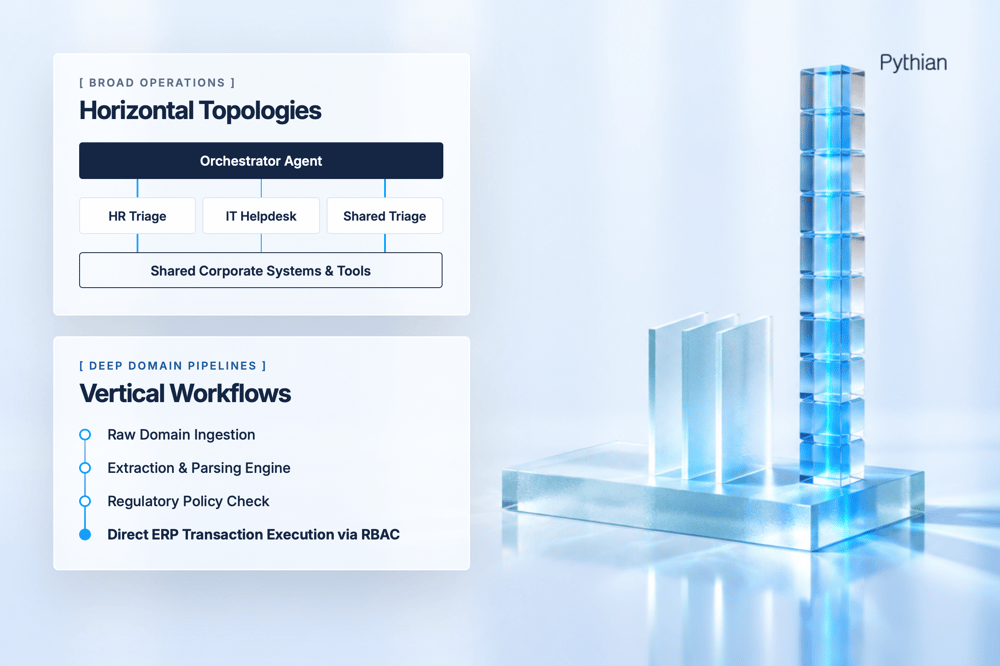
Choosing how to structure your agentic architecture with design patterns determines both implementation complexity and operational return.
Horizontal agentic topologies (cross-departmental operations)
Horizontal architectures utilize multi-agent swarms to handle broad, transactional operations that span multiple business units. A central orchestrator evaluates incoming employee or customer requests and delegates tasks to specialized sub-agents.
- Primary applications: Employee onboarding workflows across HR and IT, internal tier-1 technical support ticket resolution, and unified cross-departmental business reporting.
- Architectural advantage: High reusable leverage; modular sub-agents can be added or updated without rewriting core routing logic.
Vertical agentic topologies (deep domain-specific workflows)
Vertical architectures are engineered for deep, highly regulated operational pipelines. Rather than coordinating across general office tasks, these systems embed strict industry logic, specialized data parsers, and tight audit trails.
- Primary applications: Automated three-way invoice reconciliation within Oracle ERP, complex patient claims adjudication in healthcare, and automated compliance filings in banking.
- Architectural advantage: Extreme precision and deterministic output compliance; builds a defensible operational moat around proprietary enterprise data.
Pythian’s 6 service delivery pillars: the foundation for AI automation
To bridge the gap between architectural diagrams and dependable business outcomes, Pythian applies a disciplined six-stage AI automation delivery model:
- AI strategy and roadmap: We identify and prioritize high-value AI use cases through custom AI workshops, establishing clear business metrics and an actionable timeline before writing code.
- Data readiness assessment: We audit the underlying schemas, modernize ingestion pipelines, and implement role-based access control (RBAC) to ensure agents operate over pristine context.
- Workflow automation architecture: We map interaction boundaries between agents and human operators, establishing clear Human-in-the-Loop (HITL) checkpoints for high-risk actions.
- Core system and tool integration: We integrate AI agents into mission-critical platforms (Oracle, SAP, Salesforce, Snowflake, Google Cloud) via governed, secure API endpoints.
- Production deployment and guardrails: We deploy inference pipelines into scalable cloud infrastructure with built-in prompt injection defenses, strict JSON schema validators, and fail-safe fallbacks.
- Continuous AIOps and lifecycle governance: We track concept drift, manage token expenditures against business margins, and enforce operational SLAs around-the-clock.
The true ROI of agentic automation
The real ROI of agentic AI isn’t just about speed; it’s also about breaking the link between growth and operational expenses. Implementing these design patterns creates instant operational capacity, allowing enterprises to handle surging workload volumes while keeping labor and overhead expenses flat.
|
Agentic Pattern Applied |
Enterprise Process Automated |
Tangible Business Benefit |
|
Tool Execution & Planning |
Order fulfillment, invoice reconciliation, data triage |
Reduced operating costs: Eliminates manual data re-entry, reduces human transcription bottlenecks, and shortens end-to-end cycle times. |
|
Multi-Agent Collaboration |
Cross-departmental incident response, IT ticketing, employee lifecycle orchestration |
Scale & velocity: Resolves complex multi-step workflows without requiring proportional headcount growth. |
|
Reflection & Self-Correction |
Automated compliance validation, code generation, regulatory reporting |
Improved accuracy & quality: Minimizes costly rework, flags out-of-policy data before submission, and prevents human oversight errors. |
|
Strategic Planning & Decomposition |
Global supply chain risk modeling, dynamic capital expenditure routing, disaster recovery |
Agility & resource optimization: Dynamically restructures complex, multi-stage plans when variables change, ensuring continuous business continuity. |
|
The ReAct Framework |
Real-time fraud detection, automated claims adjudication, system incident triage |
Transparency & compliance: Guarantees fully auditable, step-by-step reasoning logs (Thought-Action-Observation) for sensitive, highly regulated decisions. |
Beyond theory: Deploy enterprise AI automation with Pythian
Moving autonomous AI agents from experimental pilots into mission-critical production requires robust data foundations, strict guardrails, and continuous operational oversight.
Partner with Pythian to transform theoretical agentic architectures into reliable, production-ready workflows that generate measurable operational ROI.
Share this
Share this
Persistent AI Agents: Why Enterprise Automation Demands an Operating Model and Strategy

HR Heroes: Simplifying People Management with Gemini